
How the Arb has been helping faculty expand how they teach

As a student at Carleton 25 years ago, Eleanor Jensen ’01 saw the Cowling Arboretum as mostly a recreational space, taking regular study breaks to run and cross-country ski through the prairie and woods. But now as a professor of art, teaching place-based drawing courses, Jensen has developed a deeper understanding of the Arb—one that she passes on to her students.
Jensen is one of many professors at Carleton who use the Arb as a secondary—or even primary—classroom. From art and science to archaeology, professors engage with the Arb for teaching, research, and sometimes materials. With spotty cell phone service in the woods, students get the chance to disconnect from their devices, commune with nature, and learn about the natural world in their own backyard.
Twice a year, in the spring and fall, Jensen teaches a field drawing class outdoors, guiding students to use drawing as a tool to notice what’s in the natural landscape around them. The course is one prerequisite for an interdisciplinary class Jensen teaches with biology professor Dan Hernández called Sense of Place: Art and Ecology of Tallgrass Prairie. In this class, students spend time in the Arb and study the prairie in different ways to learn about its unique and important ecosystem. At the end of the term, they present their final group projects in an art exhibition on campus, visually communicating their research and ideas.
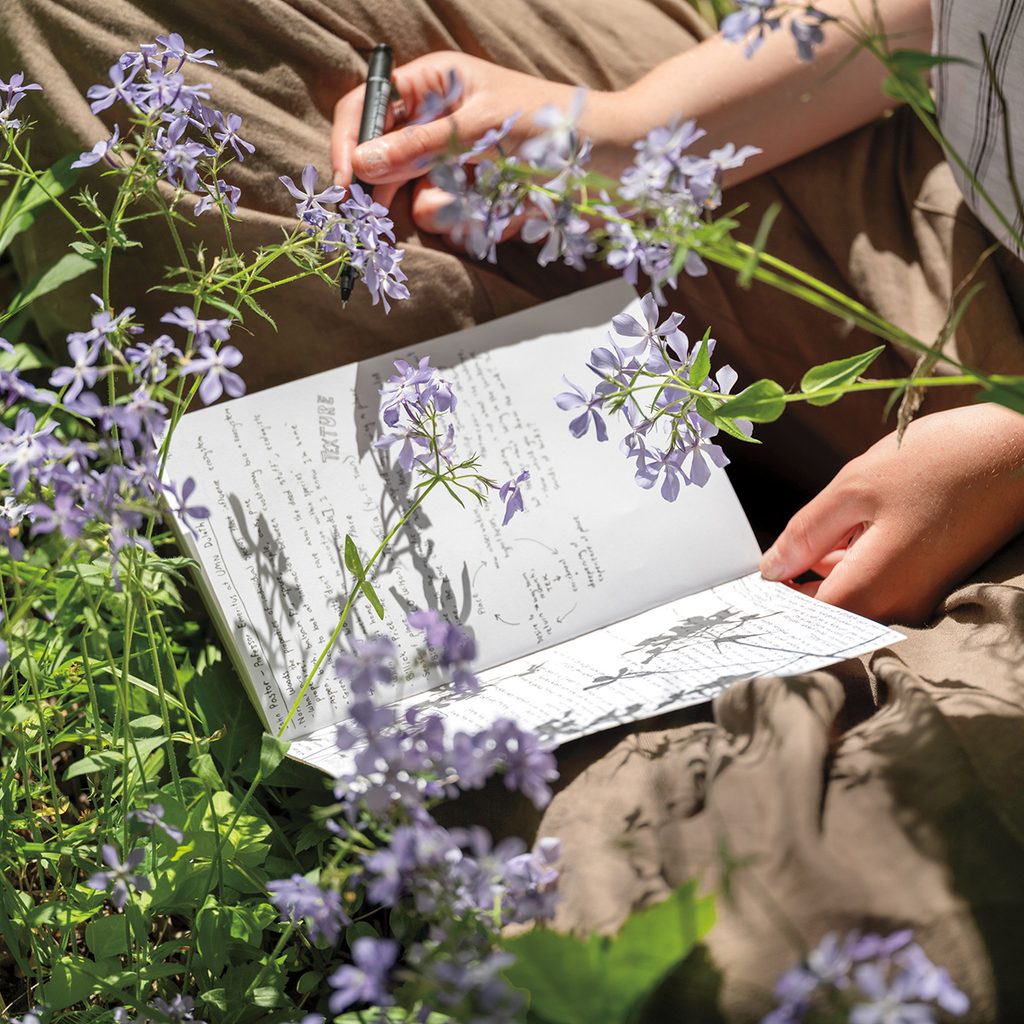
“I could teach introductory drawing skills inside, but connecting those skills to a specific place is really interdisciplinary,” Jensen says. “It’s so meaningful to expose students to the Arb, in a way that allows them to see it more fully: to understand the natural history, relationships between species, seasonal changes, Arb management work and goals, the story of the land in the past and anticipating future change. If they know it, they’ll have a connection to it and will value it.”
For Hernández, one of the goals of the class is to simply help students appreciate the prairie ecosystem, which once covered vast swaths of the Midwest but has largely been lost due to agriculture. “I want students to understand the main ecological relationships that are present in grasslands, and how they’re affected by historic land uses and then what we can do to restore, manage, and conserve these systems.”
Ruby Dirks, who graduated last spring with a degree in sociology and anthropology, took the Sense of Place class during her last term. For the final project, her group discussed making a mobile with hanging seeds—a visual representation of the various ways seeds are dispersed by humans, animals, and other natural means. Dirks has long been interested in the environment and conservation, but the class has developed her understanding as well as her sense of awe.
“There’s a sense of wonder that comes from learning more about the ecology and knowing that the root systems of the prairie grasses go so deep and they’re all connected to one another,” she says.
Some professors have been using the Arboretum for decades, witnessing how it’s changed and grown and incorporating that dynamism into their classes. Biology professor Mark McKone started his class, Population Ecology, in 1987, and he’s been teaching it ever since. The Arb was one of the main reasons he wanted to come to Carleton, and he calls it his “central tool.”
In Population Ecology, students study the plant and animal species that live in the Arb. One week, they measure tree abundance and growth rates in an area heavily populated by deer and compare it to a fenced area where deer are not allowed, to demonstrate how the animals influence forest composition. Another week, they use hot mustard to coax earthworms out of the ground to understand where they are distributed and why.
A former director of the Arb, McKone oversaw major forest and prairie restorations in the 1990s and 2000s, which greatly expanded the area of native habitats. He’s also seen the impact of climate change. When he began teaching, the first weeks of class during the spring term were too cold and snowy for fieldwork. Today, students can usually go outside on day one.
“There’s a sense of wonder that comes from learning more about the ecology and knowing that the root systems of the prairie grasses go so deep and they’re all connected to one another.”
– Ruby Dirks ’26
Most of McKone’s own published work comes from research in the Arb. He’s currently working with Hernández, whose research is also based in the Arb, to study whether seeds from as far south as Iowa will fare better in the Arboretum in the future as temperatures climb due to global warming.
“For years, the rule was that you had to use local seed sources and local genotypes. In the face of climate change, though, Dan and I think we should explore other seed sourcing techniques. The current climate is not what it was. It’s changing so fast.”
Those changes that the Arb has gone through, both positive and negative, are a theme in many of the classes taught in the space. In Austin Mason’s experimental archaeology class, students learn from Arb director Nancy Braker ’81 about woodland management and how to responsibly use the Arb as a resource for building and craft materials. Experimental archaeology is a hands-on discipline in which students attempt to recreate objects that ancient societies made, using similar materials and methods.
Mason’s research focuses on medieval Scandinavia—a subject that’s difficult for undergraduate students to study given language and geographic barriers. But with the assistance of the Arb, Mason brings Scandinavia to them. Students have gone out into an empty field in the Arb to build a Viking Age Icelandic turf house using the Arb’s own natural resources.
“Viking-Age Icelanders built a lot of turf walls because they didn’t have a lot of trees,” Mason says. “So they built houses out of sod bricks essentially. It’s also something that people did here on the prairie, particularly Scandinavian settlers.”
Using trees that were already going to be cut down and turned into wood chips, students have also built two mortuary houses for cremated remains, replicating structures built in West Sussex, England, between the fifth and seventh centuries.
Working with associate art department chair and ceramics professor Kelly Connole, Mason also uses clay from the Arb to recreate ancient pots, fired in open bonfires with wood gathered from the Arb’s brush piles.
Connole’s use of the Arb aligns with her long-held value of sustainability in art. She has worked with the geology department and others who are already digging up dirt in the Arb to source the clay that’s buried deep down.
“When they do their soil sampling, they dig trenches, like pits, to study the layers of soil,” Connole says. “Then when they’re done with that work, the ceramic students go in like scavengers and dig out some of the clay from those pits. It’s a really cool interdisciplinary connection between art and geology.”
Students can learn the art of ceramics without digging up their own clay, but Connole wants her students to understand the labor that goes into ancient arts practices. And she believes it’s what they’re craving in a fast-paced and technology-driven world.
“Sourcing the clay changes everything,” Connole says. “It’s like when you grow your first tomato, that tomato tastes totally different than a tomato that you buy at the grocery store. You learn about patience and failure. You learn about plant diseases. The way I teach ceramics is like tending a garden. It is a long, slow process of looking after something.”
Colleen Connolly is a Chicago-based freelance journalist who writes about and for higher education institutions.