
You could escape the regs, be yourself, and, well, “arb.” You just had to be back by midnight.
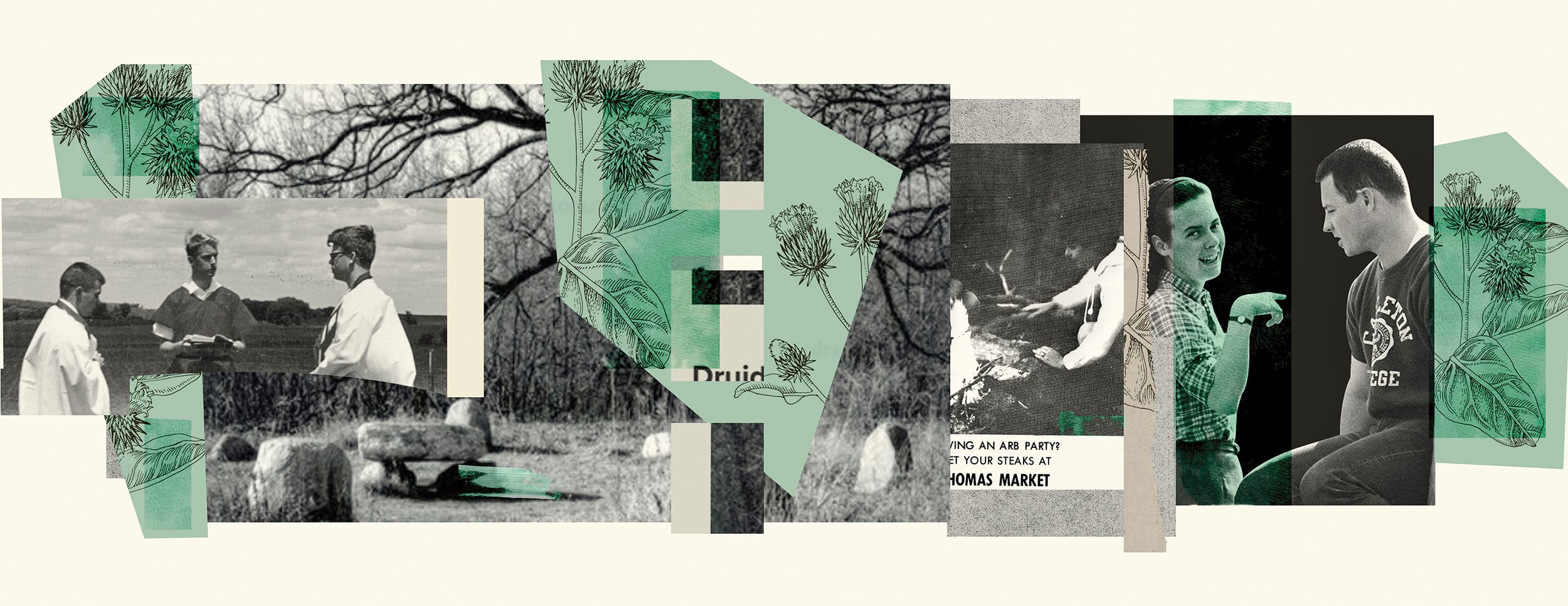
The Sixties began much like the Fifties. Men on the west side, women on the east. A few “open houses” a year when they could visit each other’s dorms: lights on, three feet on the floor, doors open at least 18 inches. No drinking. No petting. Curfew—for women.
The Arb was right there. Dark. Vast. Gone to seed since its founding overseer, a botany professor named Harvey Stork, had retired in 1955. “It was sort of understood that the college policy was in loco parentis”—the administration in the role of parent, says Carleton archivist Eric Hillemann. “But it was sort of understood that they weren’t interested in trying to closely police what went on the Arb. As long as the students were safe.”
Going Arbing
By 1964, as campuses across the country were in revolt, “the in loco parentis stuff was starting to feel intolerable,” says Stephen Ford ’65. “The whole setup seemed impelled by the strong desire of older adults to keep us from having sex.”
That spring, Ford and friends (calling themselves Truth Ltd.) published Field and Scream, a zine featuring the Arb. There were “arb tunes” (“I’m an immoral S.O.B. with a high SAT . . . happy as a eunuch, believe me”), a fake condom ad (“Live it up with the lively ones!”), and advice on “arbing.”
“People would ask, what are you doing this weekend? Well, going arbing,” Ford recalls. “And it didn’t mean a walk in nature. You got an older classmate, someone over 21, to go down to the Muni in town to buy alcohol. You got a plastic poncho to spread on the snow, your Boy Scout sleeping bag, her sleeping bag, and your two blankets from the dorm. You had a fire for roasting wieners or marshmallows. And sex.”
Truth Ltd. was hauled before the Dean of Men, who announced that the 12 students would be expelled. Ford spent a week in Chicago, visiting friends, before he and the others were allowed back. “We were all diligent students, devoted to the place. But we intended to be annoying. We wanted change.”
Home of the Druids
Some students found refuge from the “regs,” or regulations, in KARL, the campus radio station—Deborah Gavrin Frangquist ’67 and Dave Frangquist ’66 among them. On Saturday nights, they “twiddled the knobs and spun the records” in the control room lit only by the buttons on the console. “We could be a couple together and nobody batted an eye,” Dave says.
The control operator was David Fisher ’65, a fan of Celtic and Norse mythology, determined to challenge the College’s religious requirement. Most Sundays, students had to attend chapel—or another public worship service, which suggested a loophole. “David and I were more or less interested in religion,” Dave Frangquist recalls, “but the word ‘worship’ was problematic. What were we going to worship?”
Nature won out. “We could all agree nature was a good thing,” Dave says. “That gave us the perfect excuse for doing this in the Arb.” Calling themselves the Reformed Druids of North America, they held their first gatherings on Monument Hill in the spring of 1963. Fisher was their first Arch-Druid, Dave their third.
They would pray, meditate, “listen to the wind and the leaves and become aware of the space we were in,” Deborah says. They would sacrifice something, like leaves snatched from a tree. “Some members felt you couldn’t have a proper sacrifice unless blood was involved. But it seemed like vegetation was more appropriate.”
They never did get religious credit; the requirement soon ended. But the Druids carried on—including all-night vigils in the Arb. Students could get parental permission to stay elsewhere overnight, so long as they left Northfield, a proviso to prevent shacking up in local motels. “We stretched that,” says Deborah, “and indeed I went out to the Arb.”
“People were camping in the Arb and having sex, and there I was, on my own. The deal was the Druid priests would come and impart wisdom to you during the night. You were supposed to stay awake.” Deborah stuck it out, becoming the Reformed Druids’ first woman priest.
Once, in the spring of 1964, President John Nason and his wife, Elizabeth—the primary parents in loco—joined the Druids in the Arb as they passed around the “waters of life” in a chalice. “Scotch whiskey with a little water,” Dave says. “Nason took a sip and flinched. But nothing was ever said. We later learned that he preferred his Scotch neat, no water.”
“But Nason was a Quaker, so our significant period of meditation probably resonated with him. I suspect he tuned into the reality that we were experiencing something of what the Quakers call the inner light.”
A Shrub of One’s Own
Peak arbing season was spring. “It was an important release,” says Paul Menzel ’68, “for people who had studied hard all winter.”
The Upper Arb was best, the lower being prone to flooding. “Lilac Hill was where most of the courtship occurred,” remembers Sheila Murnane Cumberworth ’69. “There were enough shrubs that you could pick out your own little place. That was your rite of passage.”
There was an unspoken etiquette to arbing, says Menzel, who in 1967 helped compile a list of Carleton slang called Loosely Speaking. “An upperclassman would knock on your door: ‘Muni Run!’ And you’d write down what you wanted from the liquor store. It was a well-lubricated process.” As curfew approached, generally at midnight, there would be a scramble in the woods. (Field and Scream suggested marking your clothing with fluorescent orange, the better to find it in the dark.) If you ran into someone, you pretended not to notice.
Over time, the rites of spring branched into other Dionysian pursuits. “You had some very enterprising, very creative parties in the Arb,” Menzel recalls. “Purely social events where you could be loud and not worry about people intruding. I remember a theater group got together and cooked paella. That was a really fond time.”

Women of the Woods
For all the talk of arbing, says Cumberworth, “many women were terrified of pregnancy—it meant expulsion and public shaming, while the guys suffered no consequences. And we didn’t like that we had to be the gatekeepers, that it was our job to say no.” As a result, she says, most dating was rather innocent. “We took a lot of long walks and kept each other at arm’s length.”
The west side of campus was policed by proctors, male students paid to keep the peace. The east side had the Women’s League, staffed by female volunteers. They kept curfew, staged social events, and convened a court that sat in judgement of their peers.
The Women’s League also had a cabin, in a remote part of the Arb. The cabin was primitive, with bare bulbs and bunks, but overnights were permitted. A rare relief from curfew—and men. “In a greatly circumscribed world,” Cumberworth says, “it was our designated escape valve.”
In the spring of 1966, Cumberworth and five other women hopped on bicycles and rode out for a sleepover. They made a fire and s’mores and “gossiped for hours,” she recalls. “The intimacy of the cabin encouraged confidences.”
They went again the next spring, and the next—though this last trip started differently. Young men from town, piled in a pickup, saw the students heading to the cabin. When the women arrived, so did the men.
“They got on the roof and stomped and banged,” Cumberworth says. “We shut off the lights.” The women used a cabin phone to call the campus switchboard operator, who called her husband, who rounded up a posse to chase off the men.
In her final year, Cumberworth still enjoyed the Arb—her now-husband, Mitch Cumberworth ’69, proposed to her there. But by the end of the Sixties, as curfews loosened and dorms moved toward integration, the Arb was no longer a necessary refuge—or even necessarily a refuge. With greater freedom came greater vulnerability, and Cumberworth recalls women being taken advantage of in the woods. “It was a bittersweet time,” she says.
She and her friends never returned to the cabin.
The Afterglow
Michael Wickersheimer ’92 remembers thinking the Arb would just be a kind of “nature park,” like arboreta at other schools. Nothing special.
But as he and other young gay men began to come out, the Arb once again became a refuge. They hung out, explored, noting microclimates as pines opened onto prairie. “There’s no way to sugar-coat this,” he says, “but we also smoked a lot of weed.”
He recalls a “campus-wide cabin party with a lot of experimentation and drinking and smoking. Sex, I would imagine,” though he did not attend. (It was in fact in the Women’s League Cabin, which would be demolished in 1998.)
“College is a place where you start to grow into the person you will become,” he notes, “and put away the person that you are no longer. And for me, at least, the Arb played a part in that.”
It was a place “where we didn’t feel like we needed to worry as much about being ourselves.” A place “of freedom.”
Tim Gihring is a former editor of Minnesota Monthly magazine and the current writer and host of The Object podcast from the Minneapolis Institute of Art.
Mark Harris is a Philadelphia-based graphic designer whose work has been featured in The New York Times, The Atlantic, and New York Magazine, among others.