
Religion at Carleton
The study of religion, in the context of a liberal arts education, draws upon multiple disciplines in the humanities and the social sciences.
We examine the existential, intellectual, and social problems to which religions respond, and probe the dynamic and often ambiguous relationship between religious beliefs and practices and the social order in which they are embedded. Throughout the curriculum, religion is approached as a significant and pervasive expression of human culture, both past and present.
Through our program of study, we seek to provide students with imaginative, analytical, written, oral, and social skills that will permit them not only to gain the ability to understand human religiousness, but also to become productive members of any community. Our major gives our students many opportunities to gain the understandings and practice the skills we recognize as central to a liberal arts education.
The study of religion at Carleton also extends beyond the offerings of the Religion Department alone. Public Sociology of Religion and Saints and Society in Late Antiquity are some of the courses frequently offered in other departments that are cross-listed in Religion and for which Religion majors may receive credit toward their degrees. Many religion courses also count toward other majors and concentrations, such as American Studies, Asian Studies, Medieval and Renaissance Studies, and Gender, Woman’s and Sexuality Studies.

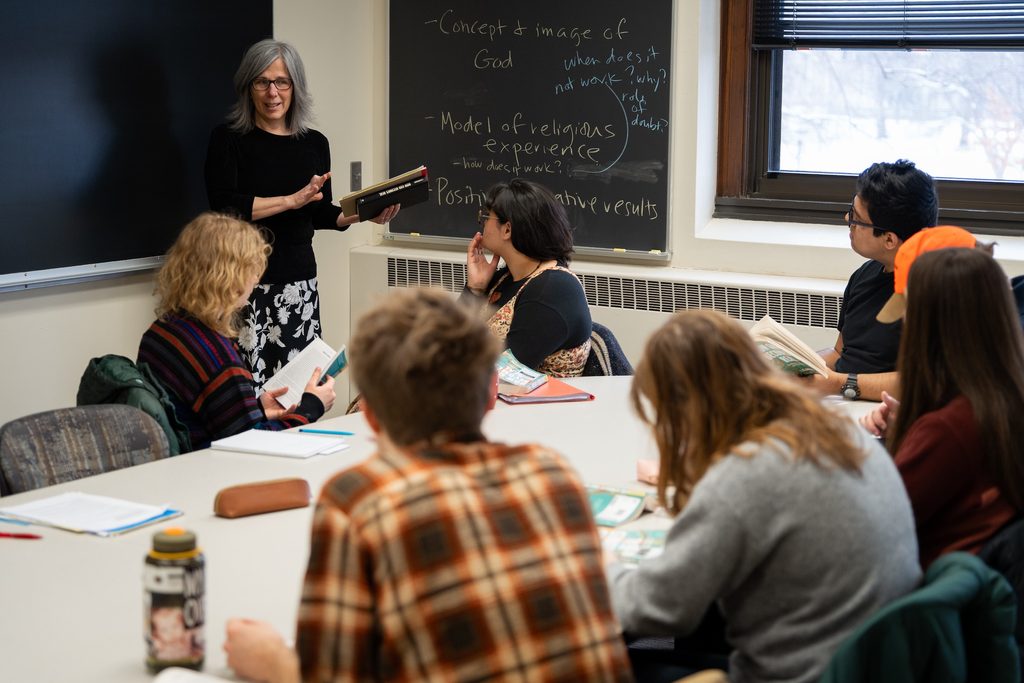
Info for First-Year Students
The study of religion in all its facets is central to the goals of a liberal education: fostering a deeper understanding of what it means to be human by examining how people in diverse times and places have developed ideas and practices related to what is most real and valuable in human life. At Carleton, the study of religion is pursued as a cross-cultural and interdisciplinary field of inquiry within the humanities and social sciences.
Why study Religion?
Despite predictions of its demise, religion remains a vital component of most human cultures in the world of the twenty-first century. Understanding of religious texts, persons, and practices is indispensable for appreciating not just the human quest for meaning in life, but the ways in which current social and political movements and institutions have developed and new ones continue to appear.
It is our hope that students who study religion at Carleton emerge with those intellectual skills that are central to a liberal arts education—reading perceptively, thinking analytically, writing clearly—together with an appreciation for the distinctive role of religion within human experience. The Department of Religion at Carleton is a place where various influences on both the subjective and the objective dimensions of human religion and religious experience can be critically examined and openly questioned in an intellectually relevant and vital manner.
Topics explored
Judaism, Christianity, Islam, Buddhism, Hinduism, Native American religions, the religions of East Asia and South Asia, and the relation between religion and, e.g., culture, race, politics, gender, philosophy, and ethics.
How to get started
Recommended courses for first-year students include:
- RELG 110: Understanding Religion
- RELG 111: Introduction to the Qur’an
- RELG 120: Introduction to Judaism
- RELG 121: Introduction to Christianity
- RELG 122: Introduction to Islam
- RELG 130: Native American Religion
- RELG 140: Religion & American Culture
- RELG 152: Japanese Religion and Culture
- RELG 153: Introduction to Buddhism
- RELG 155: Hinduism: An Introduction
- RELG 162: Jesus, the Bible, and Christian Beginnings