Physics and Astronomy at Carleton
As the fundamental natural science, physics explores the study of energy, matter, and their motion through space and time to uncover the nature of the universe. At Carleton, this vast scope—from atoms to galaxies—is reflected in an imaginative curriculum featuring almost 40 regularly offered courses and a low student-faculty ratio. With an average of 24 majors per class year, students receive close mentorship from eight faculty members across diverse fields such as Newtonian mechanics, thermodynamics, and optics. Beyond the classroom, students can engage in individual or small-group research with faculty, while those pursuing engineering careers can take advantage of the Combined Plan in Engineering offered in cooperation with Washington University in St. Louis.
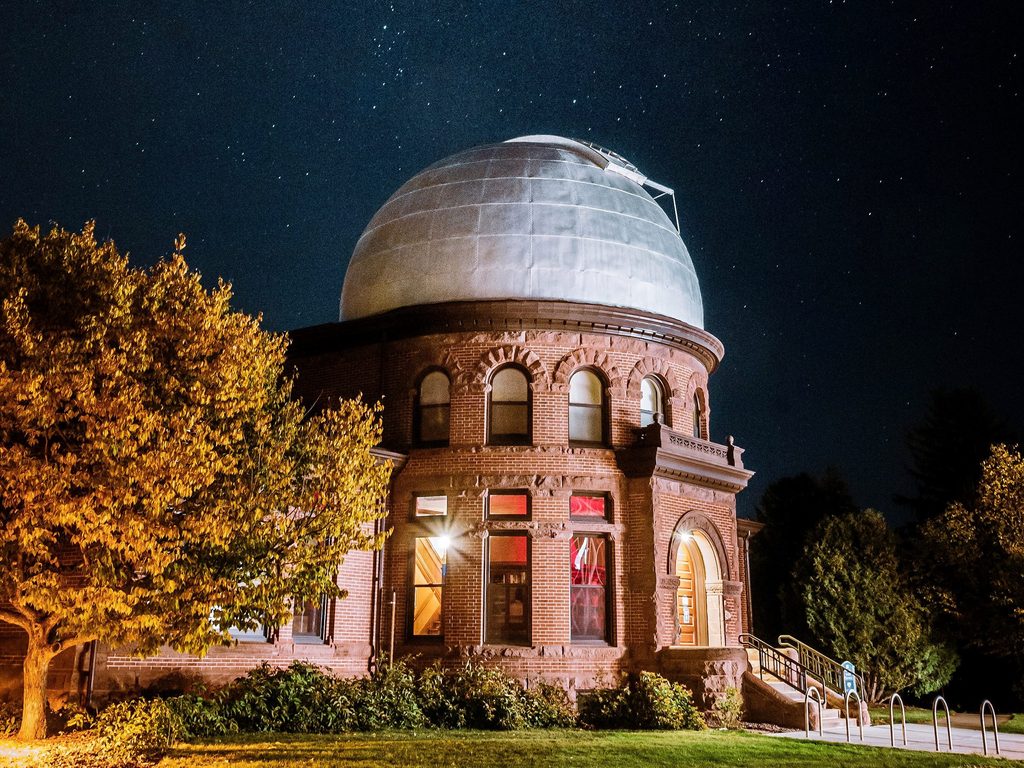
Inseparably linked with physics, astronomy offers a profound perspective for those curious about the universe on a grand scale, from elementary particles to galactic superclusters. Because a solid physics background is the best preparation for astronomical research, students pursuing this path are encouraged to major in physics while taking specialized courses like ASTR 113, which covers observational techniques and modern CCD digital imaging using the Goodsell Observatory telescopes. Additionally, students can explore ASTR 110, Introduction to Astronomy, ASTR/PHYS 232 (Astrophysics I), focusing on stellar evolution and black holes, or ASTR 233 (Astrophysics II), which examines galaxies and cosmology; these intermediate courses are offered in alternate years and can be taken in any order. This well-rounded curriculum is complemented by research opportunities with our astrophysics faculty, Professors Dreia Carrillo and Ryan Terrien, who collaborate with student researchers through Directed Research (ASTR 356) to analyze data from major observatories.
Physics and Astronomy at a Glance
Almost half of Carleton physics majors continue on with graduate training
In the last five years, Carleton physics graduates matriculated into graduate programs in physics and astronomy, engineering, or other applied fields at Brown, UC Berkeley, Penn State, the Perimeter Institute, Cornell, McGill, Northwestern, MIT, UC Boulder, UCLA, Columbia, Purdue, Dartmouth, CalTech, the University of Chicago, the U of MN, Duke, Rochester/Mayo, and other institutions across the nation.
The Physics & Astronomy Department has worked with an average of 23 majors per year from 2018-2027. (2020 national data: Carleton graduates more physics majors than 70% of US schools who offer a Bachelor’s degree in Physics)
Carleton ranks 7th in the nation among baccalaureate colleges both in the number of graduates who go on to receive a PhD in any discipline, as well as those who receive one in physics or astronomy
- From 2015-2020, Carleton averaged 7.85 majors per year going on to work on a PhD in physics or another STEM field.
- The PhD production rate for women is equally impressive. From 1990-2009, 19 women physics majors from Carleton earned PhDs in physics; Carleton and Bryn Mawr are tied for first among liberal arts colleges, and 10th among all US universities and colleges.
Carleton physics majors are leaders in the field
In recent years, two of our students received a Goldwater and a Churchill Scholarship and two recent alums received National Science Foundation Graduate School Fellowships.
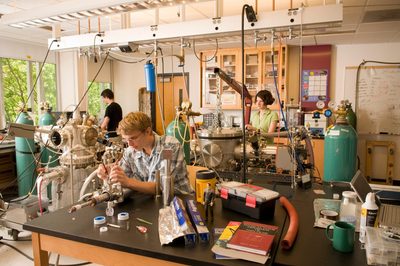
Student-Faculty Research
Doing research with a faculty member allows you to gain skills that are useful in the workforce or in graduate school, gives you a taste of what “doing physics” entails so that you can make informed decisions about what you want to do after Carleton, and allow you to get to know and work closely with a faculty member who can support you as you explore your interests in physics.
Getting Started
Students interested in majoring in physics should plan on taking Physics 131/151, Physics 142, 143, or Physics 144 in their first year. Note that Math 120 or 121 is a pre- or co- requisite for Physics 151, Physics 142, 143, and Physics 144. All introductory courses have a required 4-hour lab each week.
Events
Mon, Nov 9, 2026
- TT candidate #2 teaching demo 3:10 pm
Tue, Nov 10, 2026
- Physics Table 12:00 pm
- TT candidate #2 research talk 12:00 pm