Week 4 was another calm week; we did not have site or museum visits as a class group, however, my classes this week were interesting. On Tuesday in the class, Digital Archeology we learned about remote sensing methods in archeology, and a guest speaker, Evan Levine talked to our class about his archaeological work with LIDAR (light detection and ranging laser). Thursday was also a fun day in digital archaeology. During the first part of the class, we learned about the use and history of drones in archaeology. We learned about restrictions put on drones and other technologies and that usually, the military uses the same technology first and then eventually archaeologists also use it. One restriction is that it is necessary to have a certification to fly a drone in Greece. However, if the drone weighs less than 250g, it can be flown without a certification. So, for the second part of the class, everyone took turns flying a small drone around the classroom so that we could fly it outside more confidently during the next class.

Our first assignment in digital archeology is to make a 3D model using Agisoft Metashape. The steps of the assignment are to find a large object to model, change the camera settings (aperture, ISO, and shutter speed) to capture the best pictures for the lighting and environment, take a lot of overlapping photos all around the object, feed the photos into Agisoft Metashape, and then the software creates a 3D model. On Friday I checked out a camera from CYA (College Year in Athens) to start working on the assignment. I walked around the Nationals Gardens for a long time looking for a good object to model. There was a good variety of objects in the National Gardens to model however I wanted the lighting to be consistent for all parts of the object, I wanted the object to be short enough that I could easily capture the top of it, and I wanted it to look somewhat cool. With these conditions, my options were a little more limited but eventually, I found my target; it was a relatively smooth, graffitied concrete sphere resting on top of a platform. The sphere was completely in the shade which made the lighting conditions consistent for all parts of the object and I could step on the platform/bench that the sphere rested on so I could capture photos of the top. I took around 125 photos and used Agisoft Metashape to create the model. See the photos below to see it in Agisoft Metashape and click this link to see the finished model.
This week we only had one class period of Landscape and Material Culture; during class, we learned about the early to middle Minoan Crete. We discussed possible social functions and dynamics based on aspects of Minoan settlements. Central courts in palaces were a shared gathering space for the community. The set-up of the palaces and the Tholos tombs display a social hierarchy as parts of the palaces are less accessible and the Tholos tombs are evidence of wealth signifying social power. We learned about art such as Vasiliki, the main pottery type in Crete, pendants, and seals, some with great detail and others with more abstract designs. We also discussed what makes a state and how the early bronze age may have ended. The aspects of what makes a state that we discussed were long-distance state trade, social hierarchy with a ruling class, large population, and settlements with a division of labor, and because of large population production and surplus of agriculture is necessary.

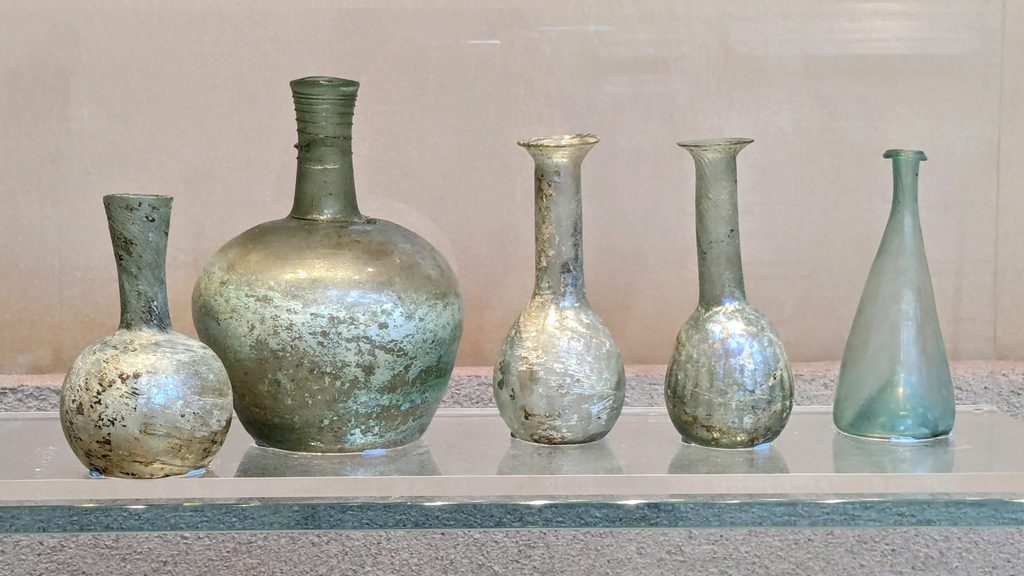
On Saturday, Sophia and I visited the Byzantine and Christian Museum. It was cool to see the differences in materials and artistic styles used during the Byzantine period versus what we have seen in class in the Neolithic and Bronze Ages. I noticed more glass material, designs made from tiles, and so many crosses. Something I found fascinating was how during this period (mid-4th century) when any religious practices that were not Christian were forbidden, ancient temples and structures were turned into Christian churches, and ancient structures’ materials were reused for the conversions.


I enjoyed this painting by Andreas Ritzos in the Byzantine Museum because of how it uses both Latin and Greek. The large letters are J(esus) H(ominum) S(alvator) meaning Jesus Savior of Mankind. Then at the bottom and in the Latin letters is Greek. The Greek at the bottom in gold letters is the Paraklitiki (Intercessionary) Troparion.