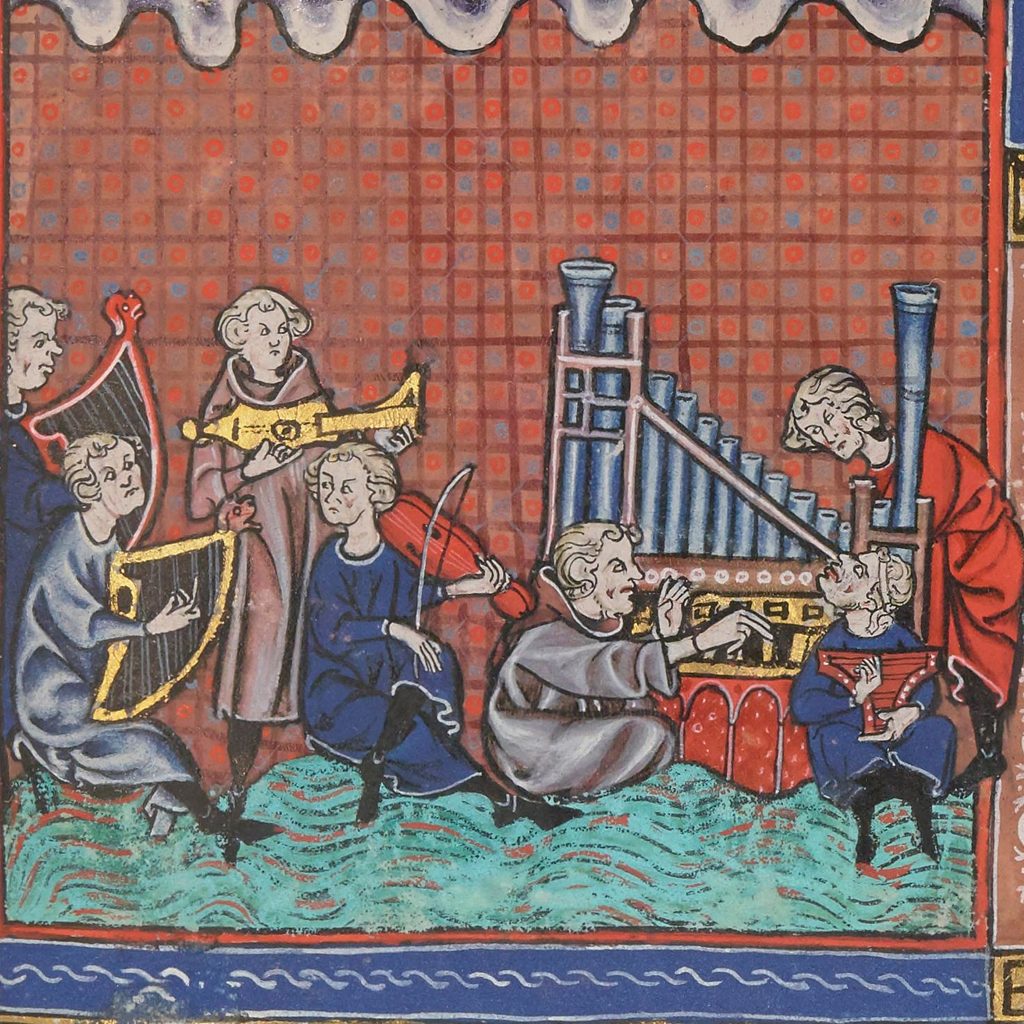
Music plays a fundamental role in societies and cultures around the world between ca. 300-ca. 1700. Closely related to mathematics, it is a theoretical discipline seeking to understand proportion, harmonies, and the mathematical music of the cosmos. It is also an embodied practice using voices and varied instruments to create sensory experiences to please human audiences as well as transcendent ones in spaces secular and religious. As a discipline focused on harmony and dissonance, music also provided apt metaphors for other dimensions of medieval life such as canon law.
Medieval and Renaissance Studies at Carleton has a long history of supporting early music in collaboration with the Music Department. Carleton Pro Musica was founded in 1969 by musicologist Dr. Robert G. Luoma and welcomed vocalists and musicians. Their first public performance was in March of 1970. After coming to the College in 1974, the late professor emeritus Steven Kelly took over leadership of the group which continued until the mid-2000s. Since 2000, MARS has invited early musicians and early music groups to campus as well as facilitated students, faculty, and staff attending area early music concerts. In Winter 2027, Professor Andy Flory will relaunch early music courses with MUSC 111: Music History before 1800 (6 credits) and MUSC 165: Listening to Weird, Old Music (2 credits)!
The College is fortunate to own an extensive library of early instruments (pictures of which may be viewed here), and we are pleased that students sometimes pursue early music and training on early instruments with Janean Hall. The Carleton choir, under the direction of Matthew Olson, regularly includes early vocal pieces in its repertoire. With Professor Yaron Klein, students may learn oud and receive an introduction to musical traditions in the Arab world more broadly.