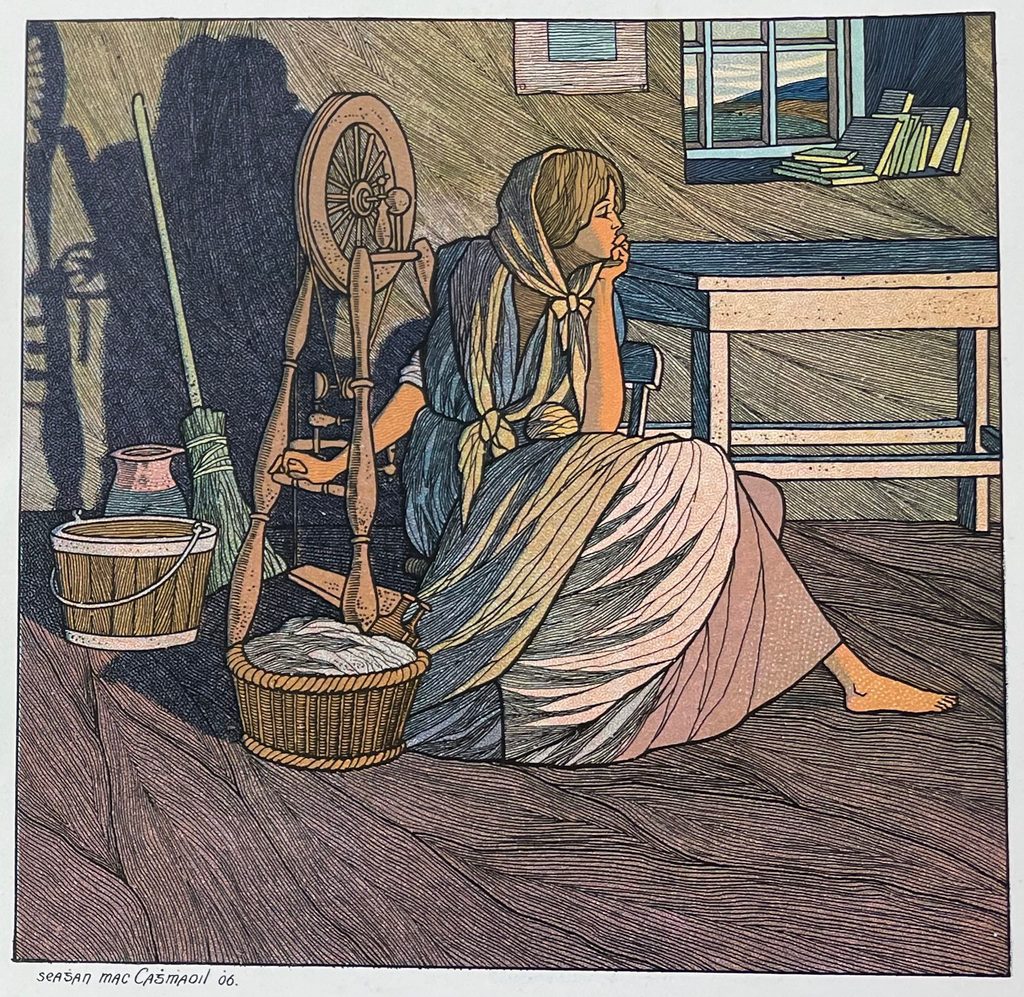
Published in Dublin: M. H. Gill & Son, James Duffy & Co.
Historians for Hire (HIST 200), taught by Laird Bell Professor of History Susannah Ottaway, provides students the opportunity to engage in a variety of public history projects, sharing their findings through public education in order to engage the broader community.
This exhibit, curated by Bella Crum ’25, Scott Hudson ’24, Evan Orjala ’24, and Maddie Smith ’24, examines a selection of early 20th-century Irish texts housed in Carleton’s Special Collections. These materials relate to the cultural revival efforts of Irish nationalists toward the end of English rule in Ireland, and were purchased as the culmination of a project completed by Emmett Forster ’24, Louisa Grader ’24, Will Mirza ’24, and Alex Wilson ’24 in the course History 335: Finding Ireland’s Past, taught in Fall 2023.
The English had maintained an imperial presence in Ireland since the 12th century, when the Norman rulers of England first conquered large portions of eastern Ireland. In the centuries that followed, successive bouts of conquest and colonization saw the entire island of Ireland subjected to English rule. During this time, oppressive laws legislating against Catholic practice, the Gaelic language, traditional Irish dress, and other Gaelic Irish customs were instituted to purposefully erase Irish culture and Anglicize the island. This colonial project, which nearly wiped out many of the customs and traditions it targeted, was a test case for future English colonial projects in the Americas, India, Africa, and elsewhere.
In the late 19th and early 20th centuries, as the self-rule and decolonization of Ireland was becoming an increasingly tangible goal, an Irish cultural revival movement was sparked to reinvigorate the “traditional” customs and culture of the island for the Irish people. This movement was led by a politically nationalist, loosely-affiliated group of people and organizations known as “cultural nationalists” who identified a distinct Irish culture as the foundation for an independent Irish nation. Their efforts to revive Irish culture included encouraging the study and practice of Irish language, music, literature, and history.
Today, this movement is preserved in music books, literature lessons, and political commentaries that are readily available for fruitful study, including right here at Carleton. This exhibit highlights a selection of texts from the period held by Special Collections that are accessible for student and community researchers and provide unique insights into this dynamic period of Irish history.
— Bella Crum ’25, Scott Hudson ’24, Evan Orjala ’24, and Maddie Smith ’24