Study a language, see the world differently

One in five Carleton students will major or minor in a language. Over 70% will study abroad. Be part of our global community!

We believe in putting language to active use in a variety of contexts. We have extensive course offerings on campus in literature and culture, but many students will use their foreign language(s) during off-campus study as well. On campus we provide a multitude of extra-curricular activities, and many courses in other disciplines (from Art History to History to Political Science) provide students with opportunities to do advanced work using their language skills.

All of the language departments and the Language Center are housed in Carleton’s Language and Dining Center (LDC) — the first new building constructed for languages on any American campus in over a century!

professor instructing students at a table
two individuals performing on stage, one playing a guitar, the other singing

Why study a language?

Even if you’ve already met the language requirement, continuing your study can transform your college experience. Advanced courses open new ways of thinking, connect you with global issues, and strengthen the very skills that define a Carleton education.

Studying a language challenges you to step outside your comfort zone, connect across cultures, and communicate with empathy — skills that shape how you think, how you learn, and how you live. In other words, language learning is not just about what you say — it’s about how you understand the world.

Rigorous courses, real community, real-world outcomes

From 100-level courses onward, you’ll build language proficiency while exploring history, politics, media, and culture. Classes are small (typically 10–25 students) and collaborative, and you’ll have countless ways to use your language beyond the classroom.

What you’ll find:

  • Courses from elementary to advanced levels that build speaking, listening, reading, and writing skills using authentic materials such as film, literature, and podcasts
  • Opportunities to connect language with other disciplines through courses in art, history, politics, and science
  • Off-campus study programs that let you live and learn in another culture while earning credit toward your degree
  • Conversation tables, film nights, cultural celebrations, and other community-building events
  • Campus testing that can lead to credentials like the Global Seal of Biliteracy, recognized by employers and graduate programs
  • Language learning that enhances majors across the curriculum and supports internships, research, and international opportunities
  • The Language Center, a welcoming hub for all language learners offering tutoring, study spaces, technology for practice and assessment, and events that build community across languages

The research behind language learning

In addition to language learning being one of the most powerful forms of critical inquiry, research shows that it offers wide-ranging cognitive, personal, and professional benefits. Scholars across disciplines have found that learning another language strengthens how we think, connect, and contribute to the world.

Research suggests that language learning:

  • Sharpens the mind. Studies show that bilinguals demonstrate stronger memory, attention, and problem-solving skills (Bialystok, Craik, & Luk, 2012).
  • Builds empathy and intercultural understanding. Language learners are more likely to recognize and appreciate diverse perspectives and show higher levels of empathy (Dewaele & Wei, 2012).
  • Expands career opportunities. A 2019 ACTFL report found that 9 in 10 U.S. employers rely on employees with language skills and that demand for multilingual talent continues to grow.
  • Develops identity and adaptability. Language study helps learners explore new sides of themselves and build resilience in unfamiliar settings (Kramsch, 2009).
  • Embodies the liberal arts in action. Language learning sits at the center of a liberal arts education — it trains students to analyze, interpret, and engage ethically with the complexity of human experience (Coleman, 2009).

Language teaching at Carleton

How are languages taught at Carleton?

Well, it depends a little bit on the language. In most cases we teach with a communicative approach in the target language. For many languages, even the first day of 101 is taught entirely in the target language! Some classes handle some explanations in English, and some literature or culture courses in some programs are taught in English. Of course, Latin and Ancient Greek use English as the language of instruction. In any case, the language of instruction (if different from English) is always indicated in the college catalog.

Want to know more?

Explore our FAQs to learn more about what it’s like to study at language at Carleton!

  • Learning German at Carleton has been an incredible opportunity to grow and develop new relationships with professors and students who share similar interests. The small class sizes and engaging teaching styles have allowed me to build confidence and proficiency in a new language.

    Riley Gibson ’26
  • I love studying Russian at Carleton because we get to learn about Russian-speaking people all over the world, from the Kamchatka Peninsula to Tashkent to the Twin Cities!

    Lexi Wallace ’26
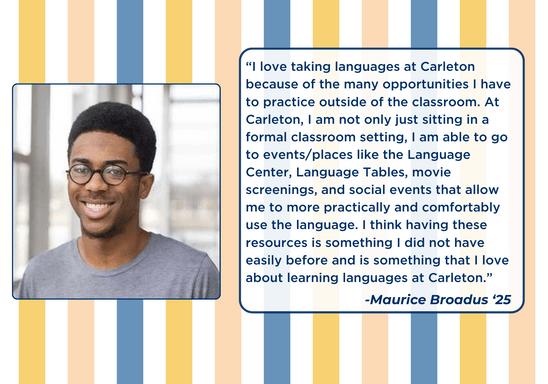
  • I love taking languages at Carleton because of the many opportunities I have to practice outside the classroom… events/places like the Language Center, Languages Tables, movie screenings, social events, and more.

    Maurice Broadus ’25
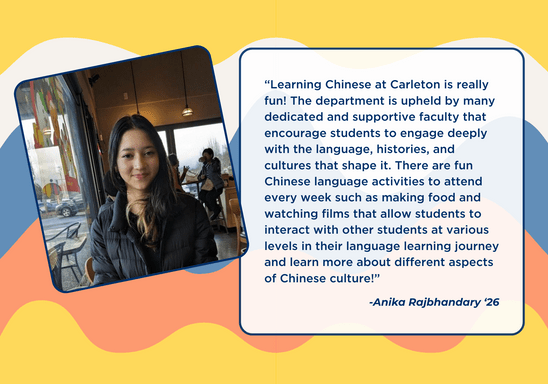
  • Learning Chinese at Carleton is really fun! The department is upheld by many dedicated and supportive faculty that encourage students to engage deeply with the language, histories, and cultures that shape it.

    Anika Rajbhandary ’26
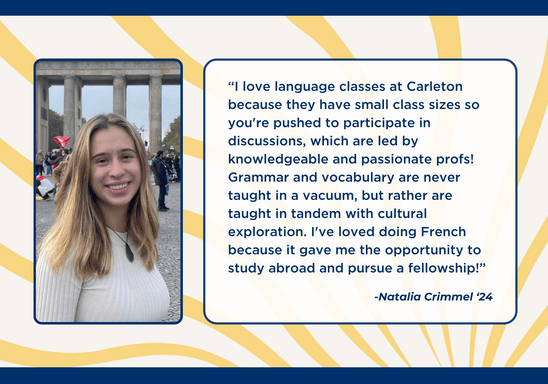
  • I love language classes at Carleton because they have small class sizes so you’re pushed to participate in discussions, which are led by knowledgeable and passionate profs! Grammar and vocabulary are never taught in a vacuum, but rather are taught in tandem with cultural exploration.

    Natalia Crimmel ’24
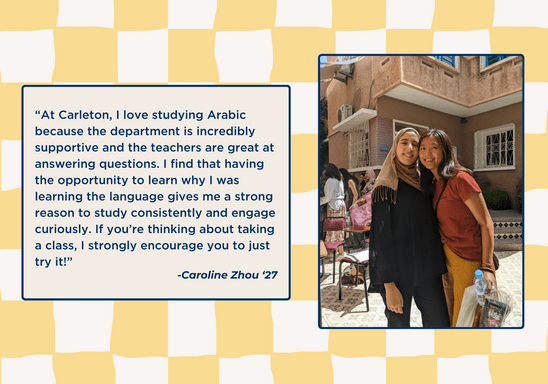
  • At Carleton, I love studying Arabic because the department is incredibly supportive and the teachers are great at answering questions. I find that having the opportunity to learn why I was learning the language gives me a strong reason to study consistently and engage curiously.

    Caroline Zhou ’27

Think beyond the language requirement

At Carleton, language isn’t just a requirement to check off — it’s at the heart of a robust liberal arts education.

Language study teaches you how to question assumptions, listen deeply, and engage with perspectives different from your own. When you learn another language, you don’t just acquire vocabulary and grammar; you learn new ways of seeing the world and new ways of being in it.