IRA serves as a strategic partner to help academic programs design and administer a sustainable, meaningful, and actionable assessment. Resources below provides framework and guidance for various academic assessment activities.
Student Learning Outcomes
Student Learning Outcomes are a concise set of mutually exclusive observable actions you expect students to demonstrate at the level you set upon conclusion of the curriculum (as they graduate). These outcomes should be aligned with the College’s mission and educational goals as well as the standards of your fields. Every SLO must be assessed at least twice in the span of 10 years (within one cycle of department review), and having the right number of SLOs facilitate sustainable assessment pace.
Tips for Writing SLOs
- 5-8 learning outcomes per major or minor
- Most programs already have them, but include the following per HLC standards:
- Disciplinary knowledge and/or skills
- Information literacy and analysis
- Research, problem-solving, and/or creative work
- Communication
- Synthesis or application skills
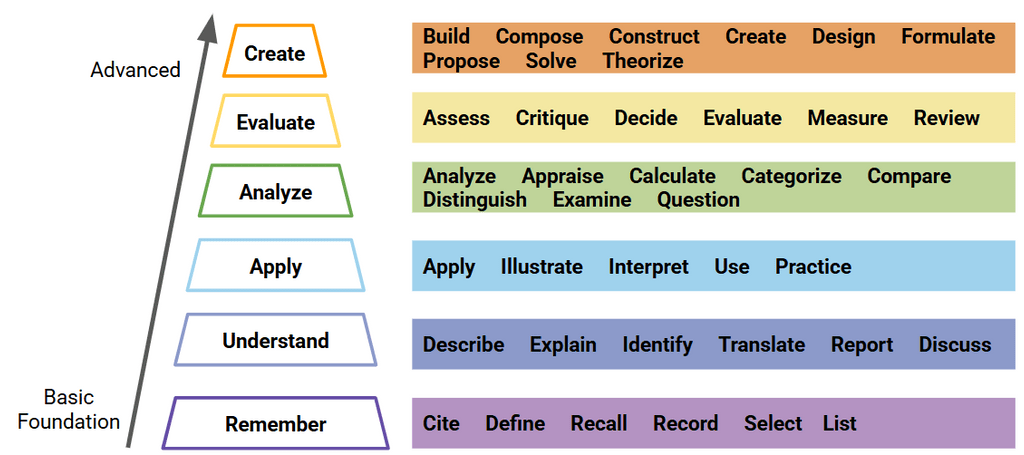
- Use observable actions as verbs (see Bloom’s Taxonomy in this resource section)
- Focus on what you can assess before students graduate.
- Use student-learning (Students will…), instead of teaching oriented expressions (This program will…)
- Keep the outcomes concise
Bloom’s Taxonomy
Bloom’s Taxonomy is a hierarchical framework used to categorize educational goals. It maps the progression of cognitive development, moving from foundational skills toward higher order thinking where learners synthesize, evaluate, and generate original ideas or products. The taxonomy offers choices of observable actions suitable for learning outcomes.
External Resources on Learning Framework & Related Teaching Resources
- Taxonomies of Learning (Harvard Derek Bok Center for Teaching and Learning)
- Bloom’s Taxonomy (Cornell Center for Teaching Innovation)
- Bloom’s Revised Taxonomy (Colorado College Assessment)
Curriculum Map
Curriculum maps show how each Student Learning Outcome (SLO) is scaffolded through the required courses and/or elective categories. It provides strategic and holistic view of the curriculum in relation to the learning goals. A curriculum map facilitates conversation about intentional course design to teach toward the SLO(s) and provides a roadmap for developmental learning.
Carleton uses three-step approach as described in the example below.
|
SLO #1 |
SLO #2 |
SLO #3 |
SLO #4 |
SLO #5 |
|
|---|---|---|---|---|---|
|
Required Course A |
Introduce |
Introduce |
|||
|
Required Course B |
Introduce |
Introduce |
|||
|
Required Course C |
Develop |
Develop |
Introduce |
||
|
Required Course D |
Develop |
Develop |
|||
|
Required Course E |
Accomplish |
Develop/ Accomplish |
|||
|
Required Course F |
Accomplish (Assess) |
Accomplish (Assess) |
|||
|
Comps |
Accomplish (Assess) |
Accomplish |
Accomplish |
Accomplish (Assess) |
Accomplish (Assess) |
Sources of Information
After developing a curriculum map, departments should identify specific coursework or learning experiences to assess each Student Learning Outcome (SLO) as it scaffolds through the program. This proactive step enables strategic, long-term planning that accounts for logistics and resources. Identifying these sources ensures consistency in the evidence collected, leading to more reliable conclusions across multiple annual assessment cycles.
Example of a Curriculum Map
|
SLO #1 |
SLO #2 |
SLO #3 |
SLO #4 |
SLO #5 |
|
|---|---|---|---|---|---|
|
Required Course A |
Introduce |
Introduce |
|||
|
Required Course B |
Introduce |
Introduce |
|||
|
Required Course C |
Develop |
Develop |
Introduce |
||
|
Required Course D |
Develop |
Develop |
|||
|
Required Course E |
Accomplish |
Develop/ Accomplish |
|||
|
Required Course F |
Accomplish (Assess) |
Accomplish (Assess) |
|||
|
Comps |
Accomplish (Assess) |
Accomplish |
Accomplish |
Accomplish (Assess) |
Accomplish (Assess) |
Example of Sources of Information
|
SLO #1 |
Comps final paper and reflection essay |
|
SLO #2 |
Exams 1 and 2, Discussion question entries |
|
SLO #3 |
Group project, final exhibition |
|
SLO #4 |
Comps oral presentation and reflection essay |
|
SLO #5 |
Comps final paper and reflection essay |
Assessment Plans
The assessment plan should address:
- How the curriculum is scaffolded to teach toward SLOs [Curriculum Map];
- Which course(s) or learning experience(s) will be used for assessment [Sources of Information]; and
- In which year you plan to assess each SLO [Schedule].
The plan should account for a preliminary year of preparation if new assessment strategies or tools must be developed prior to the assessment (data/evidence collection) year. A good plan fully captures the work that goes into assessment of each SLO.
Process of Assessment
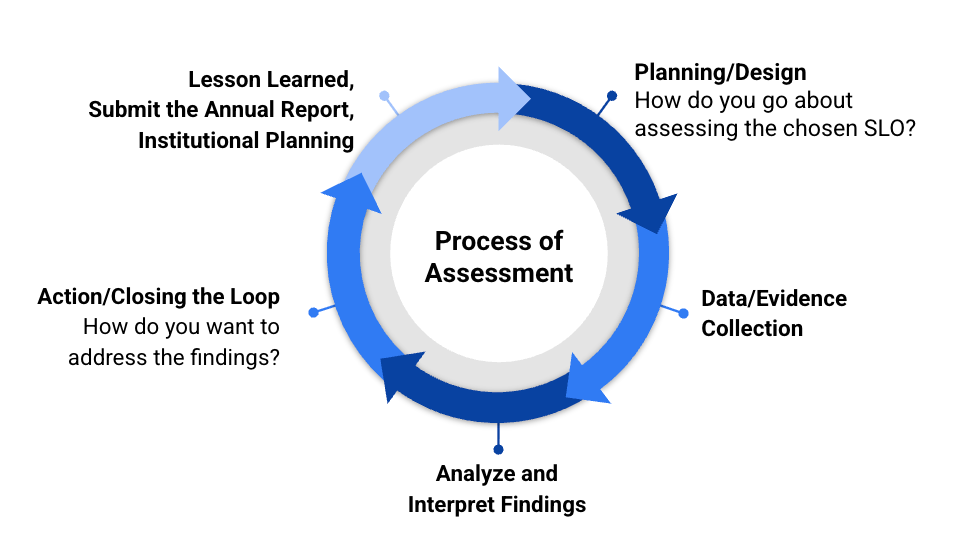
- Planning/Design – How do you go about assessing the chosen SLO?
- Data/Evidence Collection
- Analyze and Interpret Findings
- Action/Closing the Loop – How do you want to address the findings?
- Lesson Learned, Submit the Annual Report, Institutional Planning
Rubric Design
Assessment rubrics break down Student Learning Outcomes (SLOs) into manageable parts, defining clear standards for different levels of achievement. By articulating specific standards across varying levels of mastery, rubrics ensure objectivity, transparency, and consistency in the evaluation of both the overarching SLO and its individual elements. While rubrics are distinct from traditional grading, they can be effectively integrated into the grading process.
Rubric Design
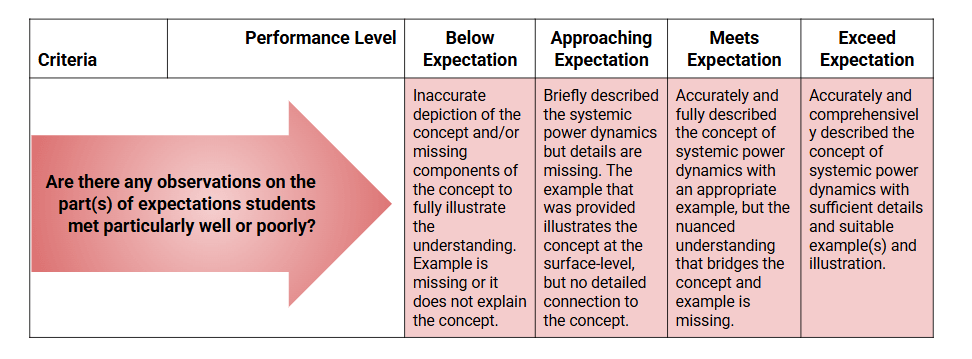
Rubrics are designed to convey three pieces of information: Performance level (blue section below); Criteria as decomposition of an SLO into smaller parts (yellow section); and Expectations (red section).
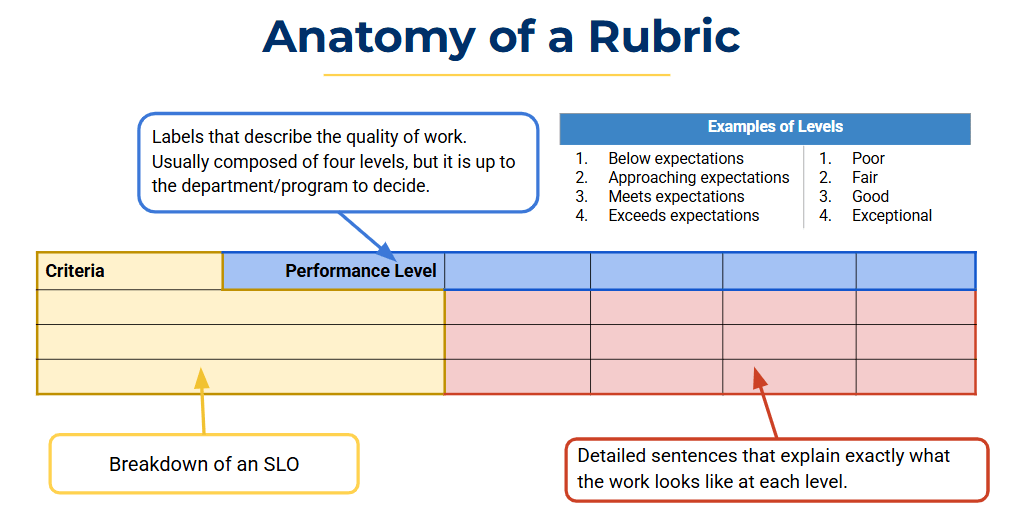
The expectations outlined in the red section serve as a roadmap, defining exactly what a student must demonstrate to meet the standards for each level of the SLO.

Use of Rubrics & Analysis
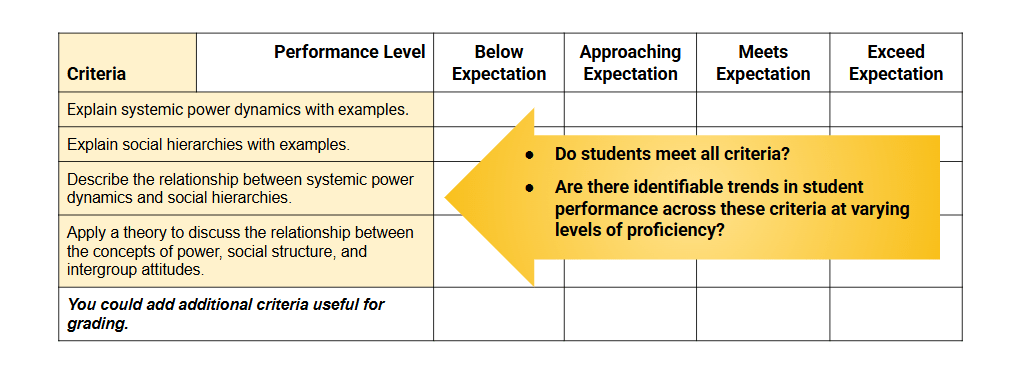
Beyond evaluating individual achievement, consistent use of rubrics across terms provides both qualitative and quantitative insights such as:
- Do students meet all criteria?
- Are there identifiable trends in student performance across criteria at varying levels of proficiency?
- Are there any observations on the part(s) of expectations students met particularly well or poorly?
External Resources on Rubrics
AAC&U VALUE Rubrics: A set of open-source assessment tools developed by the American Association of Colleges and Universities (AAC&U). They use a four-tier scale representing levels of mastery or accomplishment for various areas of learning. Access the rubrics HERE (log in required).
Assessment Designs for Small Majors/Minors
Number of students in the major/minor is often discussed as an obstacle to meaningful assessment, but we approach this as an opportunity to shift assessment conversation from methodology-driven to inquiry-informed process. Assessment can be done qualitatively or through mixed-methods approach, depending on the question.

Tips for Short-Term and Long-Term Planning

Myths about Assessment
- You cannot use existing coursework.
- No! Use as much existing student work as possible!
- Student artifacts need to be coded by non-instructor or multiple coders to establish validity and reliability.
- No! You are already evaluating the student work. Good assessment is embedded in the course design.
- You have to prove using social scientific methods what’s working and what’s not working.
- No! We are not trying to publish the work in academic journals. Process of assessment is the most valuable part of the work.
- Evidence needs to be quantifiable.
- No! Numerical representation makes it easy to quickly capture the patterns, but assessment can be a qualitative inquiry.
- We cannot use the grading rubric as assessment rubric.
- No! You can build a grading rubric that is intentionally aligned with assessment rubric.
- Faculty reflection or student feedback do not count as evidence.
- No! Feedback-based evidence is called “indirect measure” and can accompany “direct measures” which are evidence based on students’ artifacts.
- You have to find what’s not working.
- No! Finding out what’s working and how it’s working is as valuable as deficit discovery.