Senior Spotlight | A Series of Speculative & Intellectual Inquiries | Frontier Fantasies | Living London Photos
Senior Spotlight
Arthur and Olivia reflect on their tenure at Carleton, talking books, movies, classes, and other hijinks!
“Freshman year, I remember,” Olivia Ho reminisces, “Arthur reading on the bald spot and being like, wow, such an English major. . . reading classics on the bald spot all alone.”
“That’s terrible!” laughs Arthur Koenig.
“I’m less of a quintessential English major than you are,” admits Olivia. Arthur retorts, “no, you’re definitely the real deal,” teasing Olivia for her frequent use of the word “unstable.” “Narratives are unstable. Characters are unstable. Binaries are unstable. . .” he insists as Olivia confesses that she’ll have to “command-F her comps now.”
On this exchange alone, Arthur Koenig and Olivia Ho are our new favorite seniors! No, already this lie weighs heavy on us. Dear English majors, don’t allow us to cause you even a spark of jealousy; we admit we tease you in hopes that you continue reading—because, truly, this was a lively and insightful interview.
“Immediate post grad aspirations are to go couch surfing,” and make the most of the generosity of friends and family, Olivia admits. She is waiting to hear back on several fellowship and graduate school opportunities, but she might take a little bit to explore the world and her place in it first.
Arthur also expressed immediate uncertainty on his plans, spurring the epic proposal that the two “hardcore Ireland-philes” recreate their past overlapping post-OSC travels in Ireland. “Yeah, I love Dublin . . . I would love to go back.” Talk then deviates towards reminiscences of and reflections on past classes.
“My favorite class would be The Rise of the Novel with Jessica Leiman,” Olivia shares, reflecting on how the five-person class-size, incredible engagement in the class, and “this unhinged 70s version of [Tony Richardson’s] Tom Jones [with Albert Finney, where the guy is] going into brothels and having sex and meeting a beautiful lady and then falling in love,” gave this class the honor of being her favorite.
In response to Arthur’s and my laughs on this last point, Olivia expanded on her description of this memorable movie. “It was like three hours long, and there was a lot of nudity and a lot of drinking. And we’re just like, wow, this is delightful.” Olivia, chuckling over whether we at the SLM should include this, notes “You can include whatever you want. I’m an open book.”
Arthur related how Pierre Hecker’s Revenge Tragedy, “holds a special place in [his] heart” because this “strange and kooky” class truly turned him on to the English major. He also lists the fall term senior seminar as one of his favorites ever thanks to a small group and great discussions.
Both seniors are currently knee-deep in writing a brilliant comps research paper. Oliva’s topic is about the Irish author German Healy and in her paper, she looks into his work and specifically his depiction of elderly women in Ireland in the context of the late-1990s explosion of Irish economic development known as “the Celtic Tiger.”
Arthur’s comps essay is on “Egyptian literature in this 19th-century, Egyptian cosmopolitanism and sort of responses to responses to Egyptian nationalism in the middle of the century.”
Next, these intellectuals humor a classic discussion of why they love the major.
“I think it’s really cool and important to study language and how it works, and how people communicate and express ideas,” Arthur says. Olivia agrees with this sentiment, going on to emphasize that she loves “reading, and [she loves] books and literature… there’s something to be said for the love of the game!” We at the SLM profusely agree—everyone who walks the hallowed halls of Second Laird has this love for books, literature, and the game.
Are you as Ambitious as Your Professors?
We ask. Professors answer.
Our question this week to our professors was: “What is something you still haven’t done but want to do before the end of winter term?
Arnab Chakladar: Here is my 100% non-sarcastic answer (just like my previous one): “Read Pride and Prejudice and Zombies, a wonderful book I was recently given by a grateful ex-student.”
Emily Coccia: I’d say (in honor of my first Minnesota winter) that if we get the snow for it, I’d love to go snow-shoeing or cross-country skiing. If it stays dry, maybe it’ll finally be time for me to learn how to ice skate to take advantage of the cold!
Gwen Kirby: By the end of the term, I would like to have finished this sweater I’m knitting. It’s my first ever attempt at a sweater and it’s been going . . . slowly. If you see me walking around tenth week looking like a sheep that swallowed another sheep, you’ll know I succeeded!
Peter Balaam: Confirmed Meathead that I have become in my dotage, the thing I really want to do before the end of winter term is to land a 200# squat-clean at the gym. This is a goal far more poetic—even balletic—than it may possibly sound to the uninitiated. I bow deeply before the difficulty of the thing, but in fact I’m getting close.
George Shuffleton: I haven’t gone skiing in the arb yet this term, but that’s not my fault. It’s Old Man Winter’s fault that there’s no snow. If you see him, tell him how deeply disappointed I am.
Frontier Fantasies: A Talk by Emily Coccia
The English Department is very lucky to have Emily Coccia (PhD / U. of Michigan) visiting this year and next as a Robert Oden Postdoctoral Fellow for Innovation in the Liberal Arts. In that role, she’s been making a splash on Second Laird, teaching courses on ghost stories and other forms of “haunting” in US literature and, this term,to quote her course title, on “Being Queer in the 19th Century.” Last week, she gave a talk on some of her research at the Atheneum in Gould Library.
Emily’s talk traced the role of cheap and popular “dime novels” in inspiring and disseminating waves of gender exploration among especially East Coast readers in the decades after the Civil War. The talk was drawn out of a chapter of her current book project, titled Textually Queer: 19th-Century Sensation Fiction and Working Women’s Reading Cultures. We never would have thought that the popular literary form that gave birth to the Western would also be the site of restless gender dynamics and all manner of exploratory sexual and cultural self-imagining. Emily’s project is motivated by the fact that most early scholarship on the dime-novel western has regarded it as a deeply masculine genre with a presumed all-male readership. While not denying this, Emily draws from archival work to reveal the ample evidence of a robust female and queer readership as well.
These action-packed pulp-novels that East Coast readers could purchase for a few cents were populated with morally ambiguous protagonists, gender transgressive heroes (frequently women dressed as and passing as men), and plots that dabbled in anti-corporate and anti-capitalist ideology. For the queer readers that Emily studies, such frontier fantasies made it possible for working-class readers in industrialized Lowell, Massachusetts to envision thrilling and inviting alternatives to the lives familiar to them. While few will extol the strictly literary or aesthetic achievements of these books, the dime-novel helped to create version of the Western frontier as a kind of green world like Shakespeare’s forest of Arden, a fantasy zone, shaped by desire and nostalgia, advancing alternative visions of all manner of cultural, racial, sexual and gender-expression, but gradually contributing as well to processes of regulation and policing—of property, propriety, and identity—that would transform and incorporate the West.
Updates From London
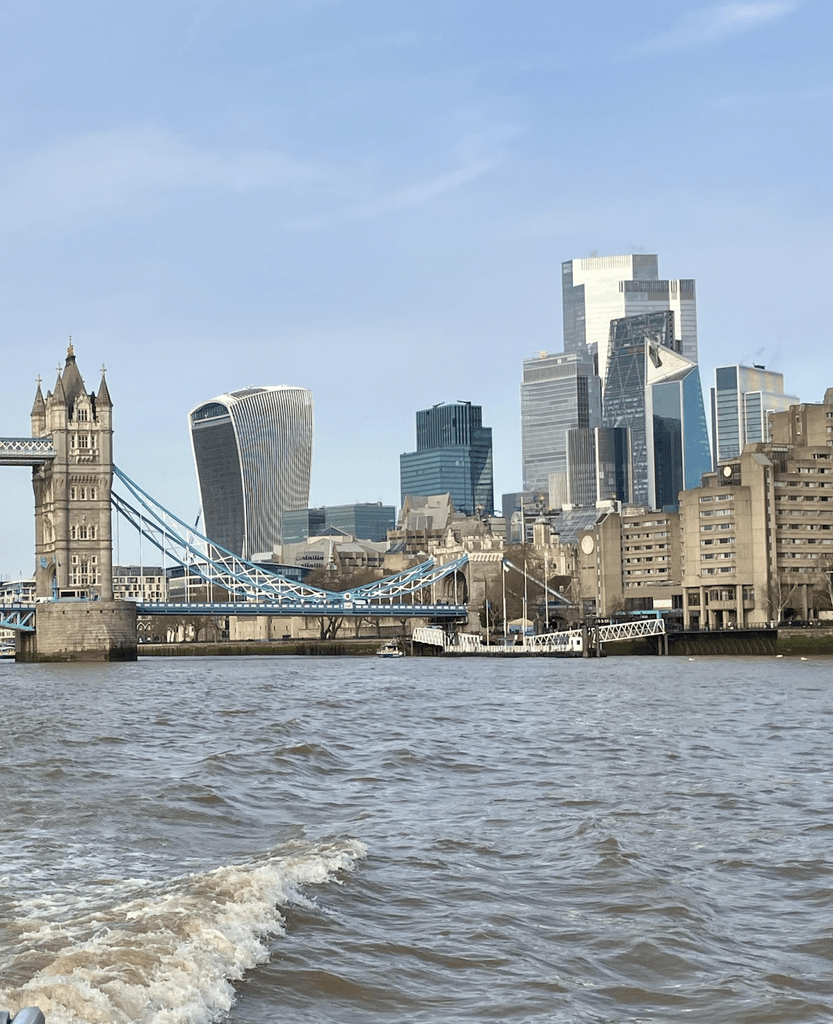
Sonia Sobel
Living in London has really increased my appreciation for art in all its forms. The amount of accessible museums and the density of productions we see helps me develop my analytical skills of not only the art itself but the vessel in which it comes in. I also have become a lot more independent and confident.
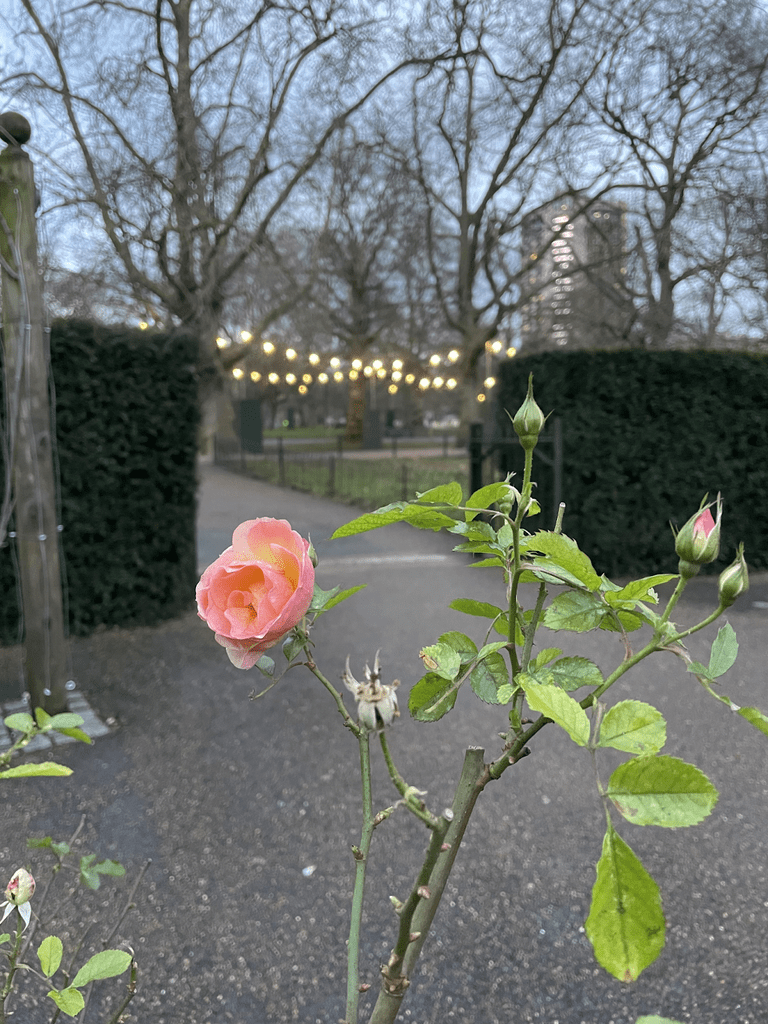
Clara McGee
Winter in London means spotting the occasional rose in Hyde Park
My favorite thing about London is the mix of old and new. There are so many historic buildings right next to modern ones; each one has a distinct personality.
Chloe Epperson
I enjoy walking around the different boroughs and seeing art displayed outside of museums/galleries. It’s like each borough is a small child and their only relation to London is their maiden name.
Lily Petersen
My favorite part is the Southwark Bridge at night.
Thomas Sorokti
A standout aspect of the program thus far has been the opportunity to see so many outstanding performances in the space of just this past month; I’ve just been reveling in the sheer quantity of grade-A theater.
Add a comment