On 6th Sunday of this term, the “ENGL 244: Shakespeare I” class was fortunate enough to see a rendition of William Shakespeare’s Henry IV, Part I. The play was put on by the theater company Ten Thousand Things and took place at Open Book, a renovated warehouse building dedicated to the literary arts community in Minneapolis. Apart from having read the play in the class and becoming fairly familiar with the text, this was my first time seeing Henry IV, Part I performed. I went into the show with a lot of enthusiasm and high expectations. What most excited me was the company’s casting choice. Henry IV was put on with an all-female cast, most of who were double-cast. Ten Thousand Things also performs at correctional facilities and women’s shelters, so they had to limit their production choices so that all of the tech, costumes and props had to be easily portable and small enough to fit in a car trunk.
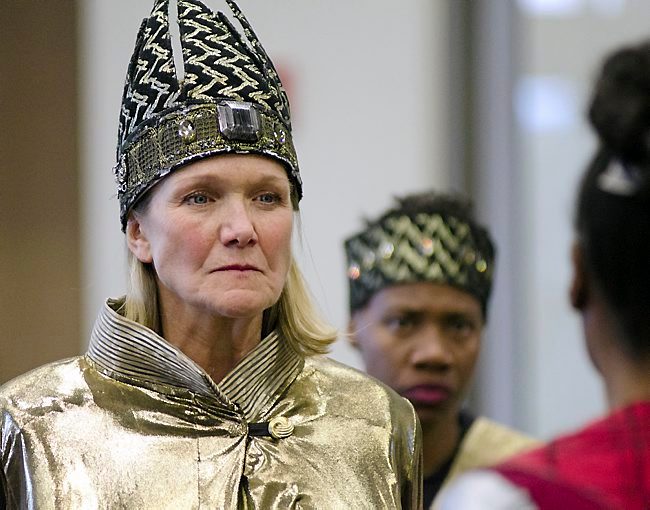
The production was by no means elaborate, but that was to their benefit. The bare set and minimal costumes let the audience focus on the story being told. The company also made great use of the props they had, the most noticeable of which was a large, movable map that helped visualize the plot. Apart from some minor interjections – Falstaff had a brilliantly timed “oh shit!” when Hal and Poins robbed him – Shakespeare’s original language was kept intact. The audience sat in an open room on four sides, creating a box with four entrances and exits on the diagonal planes. The seating arrangement allowed the play to be performed as theater in the round, which certain characters (i.e. Falstaff and Bardolph) took advantage of by engaging with audience members and occasionally drunkenly singing a-ha’s 80s classic “Take On Me”.
Throughout the performance, I was wholly engaged with the actors and completely understood the story. Although I was excited about an all-female cast, and was prepared to take note of the uprooting of Shakespeare’s text, my most intriguing afterthought was that after the first 10 minutes, I wasn’t aware that the actors’ gender identities were female. There were specific lines that made references to being womanly as jokes, and when those were spoken, I clicked back into being aware of gender. Nevertheless, apart from those moments, gender wasn’t at the forefront of my mind. Maybe this is progress? As someone who identifies as a feminist and has approximately ten weeks worth of Shakespeare under my belt (plus whatever’s left from the lucid dream known as high school), I watched an all-female Shakespeare show and didn’t notice that the actors were all women. If this is an example of being “gender-blind”, then that is a type of progress. This show was an example of an all-female production of a Shakespeare play that made a larger commentary on gender: actors who identify as women can play traditionally male roles without disturbing the plot of the production.
While the play was a positive experience, there were a few decisions I either didn’t understand or didn’t agree with. My major disappointment had to do with the execution of the director’s interpretation of Hal’s journey from the tavern to the crown. Before the performance began, the director reiterated what is echoed in the play’s abstract, which reads as such: “A young prince wrestles with questions of honor in choosing between a boisterous life with drunken thieving friends or fulfilling his father’s expectations to become a warrior in battle”. When reading the text in our Shakespeare class, we focused a lot on how Hal played two characters, that of Hal the useless drunkard and of Henry the warrior and future king, but ultimately took on the persona of Henry the future king. Where I fundamentally disagree with Ten Thousand Things’ production was the director’s choice to center the play on Hal’s indecision as well as its final execution.
There were two aspects of Henry IV that I felt the director got wrong: the depiction of Hotspur and Hal’s character development. Although the actress who played Hotspur performed wonderfully and was very engaging, the character wasn’t lovable enough. In the text, Hal’s transition is helped driven by the constant comparisons between himself and Hotspur (who represents the ideal warrior-king figure). To make this believable, the audience has to fall in love with Hotspur so that we can believe he is a worthy opponent to Hal. In this production’s interpretation, Hotspur’s rage and fighting abilities shine through. However, by dismissing the love between Hotspur and his wife and instead filling that relationship with violence, Hotspur becomes significantly less relatable. The audience wasn’t provided with an emotionally tender, yet successful warrior to whom we could compare Hal.
Hal’s character development was harder to follow. The actress did a solid job of conveying the divide between Hal the drunkard and Henry the future king through body language. When Hal was in the tavern, he was looser, louder and much more playful with his body; when he interacted with the King, he made little movement and stood stiffly in silence. However, Hal never fully committed to becoming Henry the future king. Instead of switching easily between his two selves, Hal seemed especially uneasy whenever he literally or metaphorically wore his crown. We don’t see Hal grow to become Hotspur’s equal, even though the Hotspur depicted wasn’t necessarily an equal to whom we would like to compare Hal. The director’s intention was to highlight Hal’s indecision about his life choices, and although Hal demonstrated the push and pull of these two options, his indecision at the end weakened his character. At the pivotal ending moment of the play, the King declares his intention to continue the battle. Instead of rising to the occasion as the future king, Hal literally runs away from the King in the opposite direction and then the play ends. In terms of the director’s focus, it’s accurate that we see Hal wrestling with these two options but his final act makes his transition and growth incomplete.