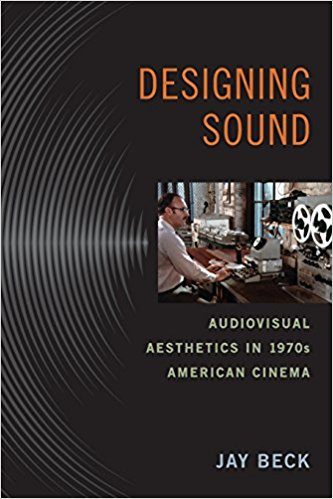
The Humanities Center at Carleton recently hosted a faculty reception for Jay Beck, Associate Professor of Cinema & Media Studies, to celebrate the publication of his new book, Designing Sound: Audiovisual Aesthetics in 1970s American Cinema (Rutgers University Press, 2016). Carol Donelan, Professor and Chair of Cinema & Media Studies, offered remarks on the significance of Professor Beck’s accomplishment and led the champagne toast.

The late 1960s and 1970s are widely recognized as a golden age for American film, as directors like Francis Ford Coppola, George Lucas, and Martin Scorsese expanded the Hollywood model with aesthetically innovative works. As this groundbreaking new study reveals, those filmmakers were blessed with more than just visionary eyes; Designing Sound focuses on how those filmmakers also had keen ears that enabled them to perceive new possibilities for cinematic sound design.
Offering detailed case studies of key films and filmmakers, Jay Beck explores how sound design was central to the era’s experimentation with new modes of cinematic storytelling. He demonstrates how sound was key to many directors’ signature aesthetics, from the overlapping dialogue that contributes to Robert Altman’s naturalism to the wordless interludes at the heart of Terrence Malick’s lyricism. Yet the book also examines sound design as a collaborative process, one where certain key directors ceded authority to sound technicians who offered significant creative input.
Designing Sound provides readers with a fresh take on a much-studied era in American film, giving a new appreciation of how artistry emerged from a period of rapid industrial and technological change. Filled with rich behind-the-scenes details, the book vividly conveys how sound practices developed by 1970s filmmakers changed the course of American cinema.