
The CAMS curriculum is unique among liberal arts colleges in its focused attention to the aesthetics of film sound as well as image. Jay Beck, Assistant Professor of Cinema and Media Studies, recently published three new essays on the aesthetics of film sound.
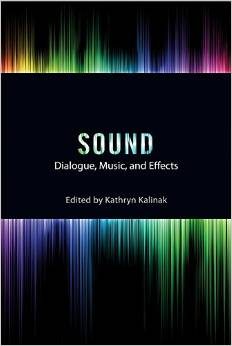
Sound: Dialogue, Music, and Effects, edited by Kathryn Kalinack and published by Rutgers University Press, the latest book in the press’ Behind the Silver Screen series, introduces key concepts, seminal moments, and pivotal figures in the development of cinematic sound. Each of the book’s six chapters covers a different era in the history of Hollywood, from silent films to the digital age. Professor Beck, along with award-winning Foley artist Vanessa Theme Ament, authored the chapter “The New Hollywood, 1981–1999,” which explores a period of neo-classicism brought on by the rapid acceptance of Dolby Stereo as a sound format after the sound experimentation in the Hollywood Renaissance of the 1960s and 70s. Although Dolby Stereo came with its own guidelines for post-production mixing, a new generation of filmmakers began to experiment with the creative potential of the system by cultivating new sound aesthetics in a number of films from the 1980s. Raging Bull, Blade Runner, Dune, Blue Velvet, The Mosquito Coast, and Indiana Jones and the Last Crusade each developed approaches that exploited the technical attributes of the sound system to envelop the audience in an ambient soundscape. The resultant aesthetics were connected directly to their stories to create a structural relationship between the films’ sound design and their narratives. In addition, the chapter explores the rise of the rock score in the 1980s and the synergy between the film, music, and music television industries around the newly-profitable compilation score albums and music videos. Lastly, the chapter demonstrates how new sound practices were introduced in the 1990s after the development of digital audio workstations and the increased dynamic and frequency ranges made possible with digital playback.
Professor Beck’s research on film sound, which directly informs the CAMS curriculum, can also be accessed in two additional recent publications: “The Democratic Voice: Robert Altman’s Sound Aesthetics in the 1970s,” in A Companion to Robert Altman, edited by Adrian Danks (Hoboken: Wiley-Blackwell, 2015) and “Submerged in Sound: Lucrecia Martel’s La ciénaga” in The Cine-Files no. 8 (Spring 2015).
Regarding director Robert Altman’s sound aesthetics, Professor Beck writes, “More than any other American director from the 1970s, Robert Altman used film sound as a means for dissolving the industrial and technological divisions between voice, effects and music in order to construct a radically new form of cinematic storytelling. During this period of innovation, Altman and his production teams were temporarily able to free sound and image relations from the biases of technological and narrative determinism. As a result, a wellspring of cinematic exploration and creativity is evident in Altman’s films from the 1970s, culminating in the decentered polyphony of Nashville (1975). This chapter examines this prolific period in Altman’s work and his cultivation of a new sound aesthetic emerging from the use of multitrack recording technology. I refer to his overarching sound aesthetic as “the democratic voice” to describe how it reorganizes the vertical hierarchy of sound recording, mixing and reproduction to allow for a non-hierarchical structure of sound that liberates the multiple speaking voices in his films and gives them equal potential to be heard. By examining how Altman’s films from M*A*S*H through Buffalo Bill and the Indians refine and articulate these techniques, this essay traces the legacy of Altman’s sound experiments across the 1970s and listens for their echoes in the work of his protégées as well as in a new generation of sound sensitive directors.”
And regarding director Lucrecia Martel’s sound aesthetics, Professor Beck adds, “Lucrecia Martel is a rarity among filmmakers. Not only does she have an astute sensitivity to the use of sound in her films, but she also writes her scripts with a soundscape in mind. Describing her method, she explains, ‘I think out the sound track well ahead of shooting – even before writing the script – and it gives me the grounding for the visuals.’ Martel’s films represent a mode of filmmaking where sound and image are conceived of as equal partners in the storytelling process, and this is borne out in a practice that emphasizes the affective qualities of sound and their ability to touch the cinema spectator. Her unique approach to dialogue, sound effects, cinematic space, in conjunction with an absence of score music, creates a haptic cinema where the combination of sounds and images trigger synesthetic sensations in the audience and engages them as active participants. As such, Martel creates an immersive soundscape in La ciénaga – foregrounding ambience, off-screen sounds, and the use of dialogue as sound effect – that reinforces the lethargy of the characters and the cultural characteristics of Salta, Argentina.”