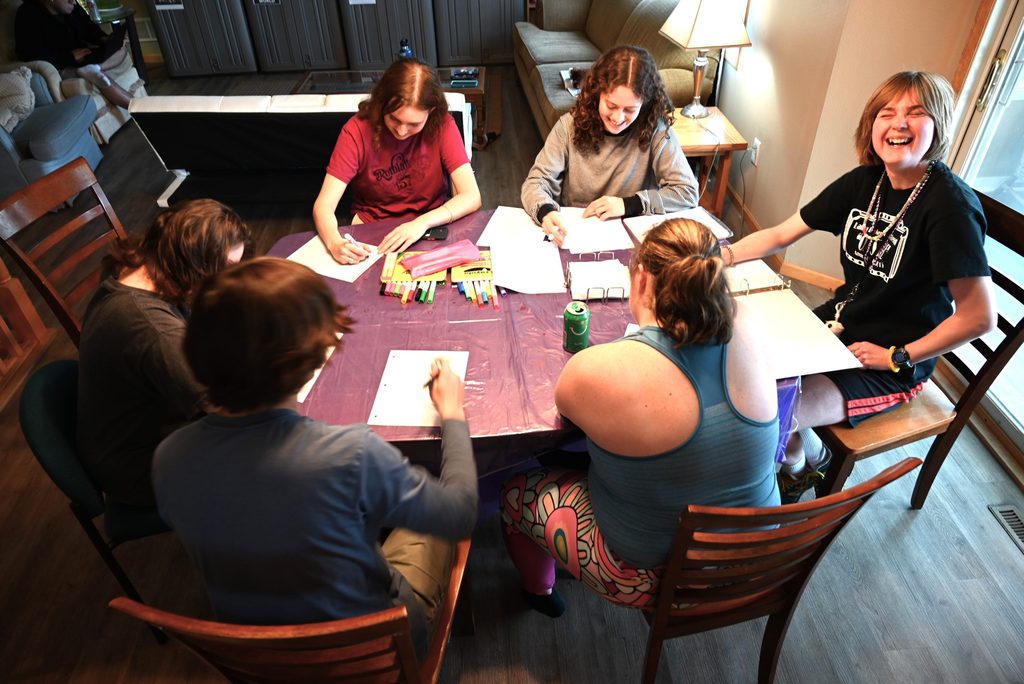
CCCE Associate Director Emily Seru recently interviewed Professor of English and American Studies Adriana Estill about her reflections on a new Academic Civic Engagement (ACE) course designed over two years with community partner Laura Baker Services Association. Integral to the course “The Poetics of Disability”, student pairs visited Laura Baker’s residential homes with residents over three class sessions. They wrote poems and drawings inspired by these encounters and the process of co-creating and relationship-building within a disability rights framework. This is an edited version of this interview.
Emily Seru: Can you tell me a little bit about why you wanted to create an ACE course?
Adriana Estill: When I thought about creating this new course one of the principles that kept coming up in disability studies was the idea that anything that you do in disability studies needs to be grounded in community; anything about the disability community should include the disability community. The book Crip Kinship: The Disability Justice & Art Activism of Sins Invalid talks about disability justice and art activism…saying, you can’t do art that is engaged with disability without also being in a fight for disability justice. So those things are paired. What does it mean to have poetry that engages the histories and bodies of people with disabilities? Once I had that, I was like, I need to find a partner that we can work with, so that the students have a chance to see that the work they do in a class is angled towards justice.
Things I’ve been thinking a lot about within the English department are: what is literature for? Why does it matter? Why should students, even if they’re not English majors, study literature? What does it give them? And certainly in disability studies so many different poets come from many different backgrounds, but their poetry is tackling the groundwork of what poetry is. At the very beginning of the class, we read Jim Ferris, who is a critic and a theorist and poet, and he says, all this poetry work, you know, people talk about lines, they talk about bodies, they talk about meter, and there’s an abled body that’s behind all of the language we use around how poetry works and what it should look like. In writing about “Crippled Poetics”, Ferris tells us, I want broken lines, I want crippled lines, just like my leg. So my goal was for my students to think about that, not just intellectually, but to try to consider what it’s like to build community and relationality in disability communities.
ES: What did you hope they would take away when only some of your students in this class are poets or English majors?
AE: The biggest thing I wanted them to come away with was a sense of the power of poetry, of why poetry is a genre that becomes so useful for human beings. So many people feel that poetry does this incisive critical work, that it isn’t just critiquing what is, but it’s making space for what can be. I wanted students to not just know that, but feel it. Once we started planning out the class, I could flesh out what that meant. I started thinking a lot about how if the students were vulnerable, not being able to control or pin down their work, they couldn’t do it individually, right? The collaboration with Laura Baker was such a core part of the class, and that part was so unsettling to them. They had very little control over what their community partners would do with them in these projects. They just had to accept that it would be what it would be, and that, I thought, was also really useful in disability studies and disability justice, just learning.
Because of how people with disabilities move through the world, disability justice premises think a lot about the world; disability justice tries to critique all of the ways that mainstream society holds a kind of ableist function. This class, I think, for a lot of them, helped inspire a different way of understanding their success – or not – within the class.
ES: How did you go about designing this course?
AE: I started early, like two years ago, I think. I built the class around the collaboration with Laura Baker. That became the known entity that I was able to put onto paper. That was super helpful because then when the class was happening, I added the readings and I added the structure after that, and it meant that during the class I never felt like I just shoehorned in the collaboration. There was time built in for it right there, in the class and the students knew it: it was written into my learning goals, it was written into the assignments, everything justified and held it up. And then that also helped me down the road, because sometimes I’d be like, oh, we didn’t get a chance to talk enough about X, Y, and Z! And then I’d remind myself, “oh, but remember, this is the core thing that we’re accomplishing in the class, this collaboration.” I don’t think I’d design an ACE course another way ever again. I think I’d always have that in mind first, no matter what kind of collaboration and relationship it is.
ES: What surprised you most in the design, in the execution, reflecting on this course?
AE: So many things surprised me! I think any time I teach a new course, I’m still kind of like, ‘ahh,’ do I know what I’m doing? No, I don’t know what I’m doing! In this case, there was a lot that I couldn’t reassure them about, whereas in another kind of class, I can reassure them more authentically. With this class, when they’re anxious about going out into the residence houses, I could just say, ‘I understand, of course, you’re nervous,’ but I couldn’t say “it’ll be okay”. I could just say “I’m ready– I want to hear how it goes and to process it with you”, and I think that’s really a shift, right?
ES: And quite the thing to model for them too, that not knowing is okay.
AE: Yeah, I think one of the things that I came away from the class with is that for some students that’s very convincing and helpful, that they were really glad to have my guidance. And I do think there were a couple of students for whom the challenge of not knowing was just… it was huge. But I do feel as I look back and think about how I taught that course, I think that I was as honest as I could be and as helpful as I could be. I modeled as much as I could, that it’s okay not to always get things right and to have these messy areas that you’re working through.
The work of the students was also something that surprised me because they struggled a lot with the ethics of what it meant to authentically co-create. I proposed it to them as you’re writing poems with the residents. For many students that became an issue – what does ‘with’ mean here? I have nonverbal residents that I’m working with, am I writing for them, how do I understand this kind of collaboration? The nature of the collaboration was so unfamiliar to them. The students struggled so much with it… in beautiful, intentional ways. And then the poems that came out of it, I thought were just fabulous. I was surprised by how the students struggled to feel as proud of those poems as I felt of their poems, and I don’t know if that’s just because a lot of times we think of poetry as written by one person, maybe, working with a group, they were less able to feel a sense of owner
ES: You talked a little about challenges, are there things that you would pull out that were especially challenging, and maybe this relates to things that you might do differently or things that you’ve learned?AE: I think a challenge that’s not ACE-related, but it’s balance-related, was just how much reading could be done and how to help them move between class time and time with Laura Baker. In general, I think about reflections as something I value so much, but reflection is sometimes very challenging to help students who aren’t getting deep – how to get deeper. So what am I going to change? I don’t know, I might change some of the reflection questions. I think I might change the frequency of it, too, because I think some of them got tired of it, some of the reflections just weren’t as good, and students may have been thinking that we just did this last week.
ES: What advice would you give to other Carleton faculty who want to design an ACE course who may have not taught one or are curious?
AE: Talk to you often. Don’t get scared away by all the information on the website, which can be intimidating, right? I do think that what made me feel like I was making decent progress was working with you. We had early talks before it was a glimmer in my head. Then we had talks when it was about a glimmer and I had more to give you. And then I gave you the learning goals, and we set up that deadline. We had the meeting with Laura Baker, and from there, you helped make sure that the ACE aspect of the course made sense. Then I dressed the syllabus but working with you was really, incredibly helpful. And you were willing to give feedback; you were willing to look at all of those early drafts.
ES: Planning well in advance is something I strongly encourage people to do. It doesn’t have to be all or nothing, you know? You can start somewhere and you’ll have ideas as you talk about it
“We will remember how it feels to lose control, and how we found the beauty of uncertainty.”
Excerpt from Introduction to Togethering – a collaborative poem by ENGL 255