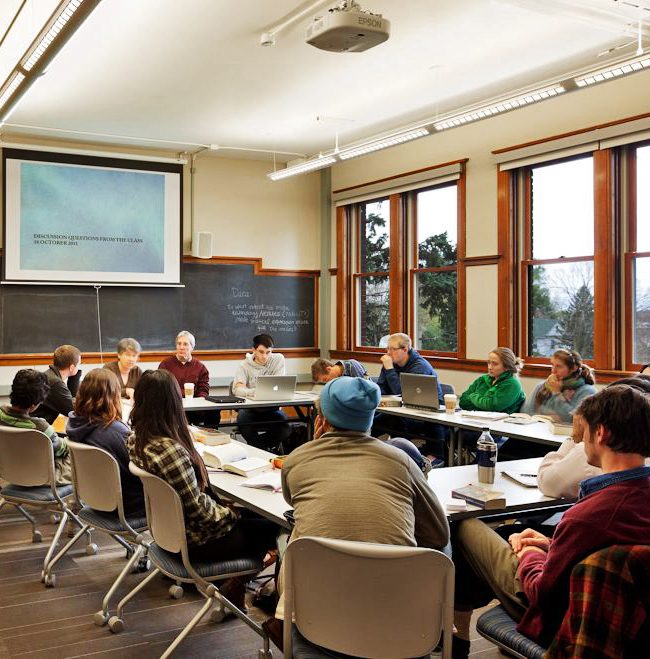
Interdisciplinary Studies is not an official department or program. It is a collection of courses that don’t fit easily into a single discipline.

Interdisciplinary Studies Courses
-
IDSC 099.01 Thinking About Feelings: The Science of Emotion
Every minute of every day is experienced through emotions. For instance, mirth and pain alike, are not only featured prominently in philosophy and the arts, but are also at the heart of scientific research. Why do we laugh? Why do we become depressed? Why do we consume horror movies? How can the intersection of science and humanities inform our understanding of individual and collective emotions? This course will introduce students to the compelling body of work surrounding emotions. This multidisciplinary approach to affect theory will allow students to explore how STEM fields and humanities are connected and interdependent.
- Summer 2026
- S/CR/NC
- 6
- No Exploration
- Sandra Rousseau 🏫 👤
-
IDSC 099.02 Field Science in Action
Explore the dynamics of Minnesota’s landscapes and living systems—from rocks and roots to birds in flight. This course provides an integrated introduction to the geosciences, ecology, and ornithology of the Upper Midwest. Students will study the geological foundations of the region, examine how climate and fire influence its forests and prairies, and investigate the ecology and evolution of native bird species. Together, these studies reveal the complex interconnections among land, life, and climate. Fieldwork, laboratory exercises, and data analysis will offer direct experience with scientific methods used to understand Earth’s dynamic systems.
- Summer 2026
- S/CR/NC
- 6
- No Exploration
- Cameron Davidson 🏫 👤
-
IDSC 099.03 Humanities: The Arts of Power and Knowledge
In this course, we will explore how key historic figures understood the connection between knowledge, power, and identity and the ways in which they sought to help their contemporaries perceive and cope with uncertainty, deception, and controversial truths. Throughout this course students choosing history as their primary field will pursue individual curated research projects that will culminate in a research essay and a public presentation based on this research.
- Summer 2026
- S/CR/NC
- 6
- No Exploration
- William North 🏫 👤
-
IDSC 099.04 Movements that Matter
This SLAI offering explores social and political activism around the world. With the help of four guests from different disciplines the instructors will examine theories of activism before exploring case studies of past and present movements, both local and international. The course culminates in a final project where students apply what they have learned to a local issue. Students will develop an action plan for a potential activist project in their own community, considering its goals, strategies, and potential impact. This hands-on project will empower students to move from theory to action, giving them the tools to make a difference.
- Summer 2026
- S/CR/NC
- 6
- No Exploration
- Paul Petzschmann 🏫 👤 · Juliane Schicker 🏫 👤
-
IDSC 099.05 Between Worlds: Home, Borders, and Belonging
In this three-week program, students explore how borders—visible and invisible—shape lives, communities, and identity. Through migration narratives, memoir-based writing, and diverse texts, they examine displacement, belonging, and transformation. The program develops critical thinking, writing, and dialogue skills, fostering empathy and creativity. Students engage deeply with questions of migration, identity, and home, preparing to navigate and understand complex social and cultural landscapes in the 21st century.
- Summer 2026
- S/CR/NC
- 6
- No Exploration
- Fernando Contreras Flamand 🏫 👤
-
IDSC 100.01 Civil Discourse in a Troubled Age
As we listen to people discussing critical issues facing individuals, communities, countries and the planet, what do we see happening? Is communication occurring? Do the sides hear each other and seek to understand another point of view, even if in disagreement? Is the goal truth or the best policy or victory for a side? What skills, approaches, and conditions lead to genuine discussion and productive argument? How can we cultivate these as individuals and communities? This Argument and Inquiry seminar addresses these questions in both theory and practice by allowing students the opportunity to read, view, discuss, and analyze theoretical discussions and case studies drawn from the past and present on a range of controversial topics.
- Fall 2026
- 6
- AI/WR1, Argument & Inquiry/WR1
-
Student is a member of the First Year First Term class level cohort. Students are only allowed to register for one A&I course at a time. If a student wishes to change the A&I course they are enrolled in they must DROP the enrolled course and then ADD the new course. Please see our Workday guides Drop or 'Late' Drop a Course and Register or Waitlist for a Course Directly from the Course Listing for more information.
- William North 🏫 👤 · Sindy Fleming 🏫 👤
-
IDSC 100.02 Reasoning and Robots
Generative AI is changing the world in ways that raise particular complications for new college students. This course tackles two questions: What does it mean to do well at college? And what does it mean to think, learn, and create when AI can do these things for us? Drawing on Cognitive Science, English, and Philosophy, we'll explore topics like AI consciousness, plagiarism, and what it means to be human in an algorithmic world. Our unlikely primary tool: role-playing games (RPGs) like Dungeons & Dragons, which uniquely reward slow, collaborative thinking. No prior AI or RPG experience required.
- Fall 2026
- 6
- AI/WR1, Argument & Inquiry/WR1
-
Student is a member of the First Year First Term class level cohort. Students are only allowed to register for one A&I course at a time. If a student wishes to change the A&I course they are enrolled in they must DROP the enrolled course and then ADD the new course. Please see our Workday guides Drop or 'Late' Drop a Course and Register or Waitlist for a Course Directly from the Course Listing for more information.
- Jay McKinney 🏫 👤 · George Cusack 🏫 👤
-
IDSC 100.03 Games, Stories, and Personas
Time to level up! This course will examine how the stories we tell and the roles we play in life shape our identities and our actions. Drawing on ideas from Psychology, Cognitive Science, Writing Studies, and other academic disciplines, we’ll explore the dynamics of role playing in a variety of contexts, from games like Dungeons and Dragons to interactions with chatbots to your work and life in college. Along the way, we’ll engage complicated questions about what it means to be human and how we know when we’re learning and thinking, and how we define ourselves as individuals and as members of communities.
- Fall 2026
- 6
- AI/WR1, Argument & Inquiry/WR1
-
Student is a member of the First Year First Term class level cohort. Students are only allowed to register for one A&I course at a time. If a student wishes to change the A&I course they are enrolled in they must DROP the enrolled course and then ADD the new course. Please see our Workday guides Drop or 'Late' Drop a Course and Register or Waitlist for a Course Directly from the Course Listing for more information.
- George Cusack 🏫 👤 · Jay McKinney 🏫 👤
-
IDSC 101 Undergraduate Bridge Experience
The Carleton Undergraduate Bridge Experience is a six-week program designed to review quantitative skills and explore how these quantitative skills are relevant to disciplines ranging from biology and physics to economics and psychology. Topics may include functions (linear, exponential, logarithmic), geometry, trigonometry, and analysis and graphical representation of data sets. Students will work in teams on several activities, including exploring Carleton-specific data sets that can be used to tell a story about the College and collaborating on problems that explore how particular quantitative skills are used in the sciences and social sciences. In addition, students review and practice their quantitative skills through self-paced work.
- Summer 2026
- S/CR/NC
- 5
- No Exploration QRE, Quantitative Reasoning
-
Student is a member of the Carleton Undergraduate Bridge Experience (CUBE) cohort.
- Lin Winton 🏫 👤
-
IDSC 110 Thinking with Numbers: Using Math and Data in Context
This course will enhance students’ quantitative skills and provide opportunities to apply those skills to authentic problems. Topics covered will vary depending on students in the class; possible topics include unit conversions, significant figures and estimation, exponents, logarithms, algebra, geometry, probability, and statistics. We will explore how these skills are relevant in contexts ranging from making personal finance decisions to understanding medical research reports.
- First Five Weeks, Fall 2026
- S/CR/NC
- 1
- No Exploration
-
Student is a member of the Carleton Undergraduate Bridge Experience (CUBE) cohort.
- Lin Winton 🏫 👤
-
IDSC 111 Perspectives on the Humanities
What are the humanities? What is research in the humanities? And what can you do with a degree in the humanities? Come find out in class sessions across two terms exploring different humanistic fields, research and job paths. Most weeks, a humanities professor will visit our class to discuss their work as well as exciting new trends in their disciplines. We’ll learn how different humanities disciplines think about evidence, make arguments, and conduct research in the service of exploring fundamental questions about what it means to be human. In other weeks, we'll have visits from librarians, the career center or Carleton alums. Students will discuss an array of humanistic topics in a low-stakes environment. This course is especially recommended for students interested in exploring the variety of possible majors and minors within the Humanities.
Repeatable: This course is repeatable for up to 2 credits.
- Winter 2027, Spring 2027
- S/CR/NC
- 1
- No Exploration
-
Student must be a member of the IDSC 111-01 cohort. Cohort membership determined by the instructor.
- Daniel Groll 🏫 👤
-
IDSC 121.02 Entrepreneurship and the Liberal Arts
Careers in entrepreneurship naturally connect to a liberal arts education in at least two ways. First, whether for-profit or social, startup ventures arise as solutions to complex problems. By focusing on alternate ways of thinking, the liberal arts prepare students to generate new solutions to problems of all sorts. Second, the work of the entrepreneur transcends disciplinary boundaries. In any given day, the needs of a business may involve the science of product development, political science of regulation, psychology of brand definition, economics of pricing, and more. Through conversations with Carleton alumni and parent entrepreneurs, this class explores the connection between a liberal arts education and work developing startup enterprises.
- Second Five Weeks, Fall 2026
- S/CR/NC
- 1
- No Exploration
- Nathan Grawe 🏫 👤
-
IDSC 121.03 Careers in Biology
What can the study of biology mean for your career? This course explores the professional trajectories of liberal arts students, specifically focusing on the habits of mind and problem solving strategies developed through the study of biology and how these skills can be applied to a variety of career paths. Through alumni interviews and applied activities, you'll gain a broad sense of the wide range of post-college possibilities with a biology degree.
Repeatable: This course is repeatable.
- Second Five Weeks, Fall 2026
- S/CR/NC
- 1
- No Exploration
- Andrea Kalis 🏫 👤
-
IDSC 121.01 Careers, Language, & the Power of Cultural Insight
What can the study of languages and cultures mean for your career? This course explores the professional trajectories of liberal arts students, specifically focusing on the habits of mind and problem solving strategies developed through language and culture study and how these can be applied to a variety of career paths. Through alumni interviews and applied activities, you'll gain a broad sense of the wide range of post-college possibilities for someone with language and intercultural skills.
- Second Five Weeks, Winter 2027
- S/CR/NC
- 1
- No Exploration
- Juliane Schicker 🏫 👤
-
IDSC 121.02 Careers in Management and the Liberal Arts
Scholar of business Peter F. Drucker wrote: "The fundamental task of management remains the same: to make people capable of joint performance through common goals, common values, the right structure, and the training and development they need to respond." A liberal art, management allows its possessor to perceive, analyze, and formulate approaches to problems and opportunities that involve diverse people, knowledges, materials, contexts, relationships, and forms of communication. Through conversations with Carleton alumni and parents, this class explores connections between the liberal arts and the many forms, scales, and contexts of management in the world of work.
- Second Five Weeks, Winter 2027
- S/CR/NC
- 1
- No Exploration
- William North 🏫 👤
-
IDSC 141 Computation, Past and Present, in England Program: Computing with Context: Alan Turing, Gender, and Computing
This course will address a cluster of topics related to a broad gender-based context for computing. The starting point is Alan Turing himself: a hero for his code-breaking work during the war, Turing was also a gay man chemically castrated by the British government who (likely) died by suicide after enduring that treatment. The course will spiral outward from Turing to include a broader set of topics related to gender and sexuality in computing, ranging from Turing’s era to the present. Specific topics will vary based on the interests of available experts in aspects of gender and computing.
Not offered in 2026-27
- S/CR/NC
- 2
- No Exploration
-
Acceptance in the Carleton OCS Computation, Past and Present, in England program.
-
IDSC 198 FOCUS Colloquium
This colloquium is designed to give students participating in the Focusing on Cultivating Scientists program an opportunity to learn and use skills in scientific study, reasoning, and modeling. The topics of this project-based colloquium will vary each term, and allow students to develop competencies in areas relevant to multiple science disciplines.
- Fall 2026, Winter 2027, Spring 2027
- S/CR/NC
- 2
- No Exploration
-
Student is a member of the FOCUS 2 cohort.
- Deborah Gross 🏫 👤
-
IDSC 202 MMUF Research Seminar
This seminar develops the skills needed to engage in and communicate advanced research. Each participant will work and present regularly on their ongoing research projects, and participate actively in an ongoing series of workshops and conferences. The seminar will also discuss in depth the nature of academia as institution and culture, and the role of diversity in the production of knowledge and teaching in American higher education. Open only to students with MMUF fellow status.
- Fall 2026, Winter 2027, Spring 2027
- S/CR/NC
- 2
- No Exploration
- Cherlon Ussery 🏫 👤
-
IDSC 203 Dialogue Across Differences
This course prepares students to facilitate peer-led conversations about diversity in the Critical Conversations Program. Students learn about categories and theories related to social identity, power, and inequality, and explore how identities including race, gender, class, and sexual orientation affect individual experience and communal structures. Students engage in experiential exercises that invite them to reflect on their own social identities and their reactions to difference, diversity, and conflict. Students are required to keep a weekly journal and to participate in class leadership. Participants in this class may apply to facilitate sections of IDSC 103, a 2-credit student-led course in the following term.
Not offered in 2026-27
- S/CR/NC
- 6
- IDS, Intercultural Domestic Studies No Exploration
-
Student has been approved to register for IDSC 203 AND is a member of the IDSC 203 cohort.
-
IDSC 204 Revision Seminar for Humanistic Writing
Students in this course substantially revise essays written in prior courses with an eye to submitting them for publication in undergraduate scholarly journals. Paper topics must fall, broadly, within the scope of the humanities, arts, and humanistic social sciences. The seminar will practice peer feedback and will explore different revision techniques (such as reverse outlining, memory drafts, strength-and-weakness mapping).
Not offered in 2026-27
- S/CR/NC
- 2
- No Exploration
-
IDSC 234 Why Haven’t We Cured Cancer Yet?
Cancer is one of humanity’s oldest and most persistent medical challenges. While massive strides have been made in understanding how cancer develops and in treating certain types of cancers, we are far from a universal cure. This interdisciplinary class will explore the complexities around what cancer is; how advances in technology have transformed what we know about it (and how we talk about it); and how existing treatments work and were developed. Along the way we will draw on perspectives from many disciplines including biology, computer science, ethics, public policy, statistics, and others.
- Winter 2027
- 6
- No Exploration
- Layla Oesper 🏫 👤
-
IDSC 238 Vaccines: Science, Skeptics, and Stakeholders
Vaccines are often touted as one of humankind’s greatest biomedical achievements. They have undoubtedly prevented hundreds of millions of deaths from infectious diseases since their discovery. Yet, there remain many obstacles that prevent their wider development and dissemination. Among these are the technological challenges associated with vaccine development, the well-funded anti-vaccination movements that often thrive on and spread misinformation, and economic hurdles that affect the production and equitable distribution of vaccines. Through an interdisciplinary lens that incorporates material from biology, psychology, and economics, this course will allow students to reach an integrated understanding of vaccines.
Not offered in 2026-27
-
IDSC 240 Nudging Our Way to a Better World
This discussion-based seminar, open to all students, will examine the most common cognitive biases that keep us from making good decisions—and will explore the potential of behavioral science to produce better outcomes in areas ranging from saving the planet from environmental ruin to promoting more gender equality and increasing organ donation. Along the way, we will examine the controversy surrounding the work of two famous behavioral scientists accused of falsifying data on a massive scale and producing impossible-to-replicate results. Together we will wrestle with the question, “Can behavioral science save the world?”
Not offered in 2026-27
- S/CR/NC
- 2
- SI, Social Inquiry
-
IDSC 250 Color!
If you had to explain to a blind person the nature of color, how would you describe it? Is it a property of objects, oscillations of an electric field, a feature of how the eye generates electrochemical signals to send to the brain, or perhaps a property of the experiences themselves? This team-taught course takes a multidisciplinary approach to color, drawing from physics, psychology, and philosophy. We will explore topics such as the nature of light, visual anatomy, the process by which light is converted to a neural code, color mixing, linguistic differences in color processing, and how color leads us to confront the tension that sometimes exists between appearance and reality.
- Winter 2027
- 6
- No Exploration
-
Student has completed any of the following course(s): One Introductory PHIL or PSYC course higher than 110 or One Introductory PHYS course higher than 130 with a grade of C- or better.
- Julia Strand 🏫 👤 · Jason Decker 🏫 👤 · Marty Baylor 🏫 👤
-
IDSC 251 Windows on the Good Life
Human beings are always and everywhere challenged by the question: What should I do to spend my mortal time well? One way to approach this ultimate challenge is to explore some of the great cultural products of our civilization–works that are a delight to read for their wisdom and artfulness. This series of two-credit courses will explore a philosophical dialogue of Plato in the fall, a work from the Bible in the winter, and a pair of plays by Shakespeare in the spring. The course can be repeated for credit throughout the year and in subsequent years.
- Fall 2026, Winter 2027, Spring 2027
- S/CR/NC
- 2
- HI, Humanistic Inquiry
- Laurence Cooper 🏫 👤
-
IDSC 256 Computation, Past and Present, in England Program: Privacy, Anonymity, Secrecy, Surveillance
Sometimes you don't want others to know what you just did or said; sometimes you don't want them to know it was you who just did whatever it was. (You'll have your own examples.) We'll explore some technological tools that help enable secrecy: keys, ciphers, incognito mode, and cryptocurrency, to name a few. And we'll look at countervailing forces pushing towards transparency and "sunlight": codebreaking, deanonymization, facial recognition, etc. We'll discuss the risks when either set of tools is much stronger than the other, and the ways that different people — and perhaps different cultures — weigh the comparative risks differently.
Not offered in 2026-27
- 6
- SI, Social Inquiry
-
Acceptance in the Carleton OCS Computation, Past and Present, in England program.
-
IDSC 257 Sense of Place: Art and Ecology of Tallgrass Prairie
This course is a collaboration between students of field drawing and ecology that will foster an interdisciplinary dialogue on the Tallgrass Prairie Ecosystem. Students will work together to develop a project that explores how ecological study and artistic expression can deepen their understanding of this landscape. The course will involve field trips in the Carleton Arboretum, guest speakers, directed readings and culminate in a gallery exhibition.
Not offered in 2026-27
- S/CR/NC
- 2
- No Exploration
-
Student has completed any of the following course(s): ARTS 113 or BIOL 210 or BIOL 321 or ENTS 210 with a grade of C- or better.
-
IDSC 258 Consensus or Contentious? Controversies in Science Then and Now
Almost every global challenge confronting humankind requires some level of engagement with science and technology. However, finding solutions to our most pressing problems also requires an understanding of how science operates within its social, political, and cultural context. This course will explore the relationship between science and society by examining a series of controversies in science from both the past and the present. We will investigate topics such as biological and social concepts of race, the use of unethically obtained scientific results, the ethics of genomics research, legislation over vaccination mandates, “parachute” science, and climate change denial. Examining the role of science in society will help us understand issues related to the use of evidence, expertise, and the relationship between science and politics. By wrestling with current and historic scientific controversies, we will examine the ways in which scientific disagreements are often as much about values as they are about research methods.
- Winter 2027
- 2
- No Exploration
- Antony Adler 🏫 👤 · Rika Anderson 🏫 👤
-
IDSC 280 Learning from Internships
This course is intended for students who secure an internship that requires course credit as a condition of hiring. Carleton does not grant credit for internships, but in some appropriate circumstances, we grant credit for additional academic work associated with an internship. Although the specific nature of internship experiences will vary, internships are opportunities to apply and extend one's academic skills and interests into work in non-academic settings. This course will involve carefully monitored work experiences in which a student has intentional learning goals which will be assessed through reflective writing and related readings.
- Fall 2026, Winter 2027, Spring 2027
- S/CR/NC
- 1
- No Exploration
-
This course requires permission from the instructor. Please see the public notes for the permission requirements you must meet to register.
To request permission, follow the instructions for requesting a prerequisite override.
Please note: the link will open in a new window. Once you have received permission from the instructor, you will be able to return to this page to register for the course.
- Melissa Eblen-Zayas 🏫 👤
-
IDSC 285 Ethics of Civic Engagement
This course explores vexing ethical questions raised in academic civic engagement practice. With structured reflection on students’ varied civic engagement experiences and a group project aligned with the instructor’s work, students will consider questions arising from asymmetries of power, the relationships between scholarship and advocacy, scholarly and community knowledges, empathy with others and a student’s own moral commitments, and practices of civic engagement and community organizing. Offered biennially by rotating faculty, course themes will vary accordingly. The 2023 theme is Indigenous engagement in Minnesota.
Not offered in 2026-27
-
IDSC 289 Science Fellows Research Colloquium
This colloquium develops the skills needed to engage in and communicate scientific and mathematical research. Topics will vary each term, but will include searching and reading the primary literature and communicating results orally and via posters. The colloquium will also explore the landscape of academic scientific research and how to negotiate the expectations of being a research group member.
- Fall 2026, Spring 2027
- S/CR/NC
- 1
- No Exploration
-
Student is a member of the IDSC 289-01 cohort. Cohort membership determined by the instructor.
- Daniel Hernández 🏫 👤
-
IDSC 298 FOCUS Sophomore Colloquium
This colloquium is designed for sophomore students participating in the Focusing on Cultivating Scientists program. It will provide an opportunity to participate in STEM-based projects on campus and in the community. The topics of this project-based colloquium will vary each term.
- Fall 2026, Winter 2027, Spring 2027
- S/CR/NC
- 1
- No Exploration
-
Student has completed any of the following course(s): IDSC 198 with a grade of C- or better during their first year.
- Deborah Gross 🏫 👤
-
IDSC 400.01 Narrative and Performance Studies Integrative Exercise
Integrative Exercise for Narrative and Performance Studies special majors.
- Fall 2026
- S/NC
- 3 – 6
- No Exploration
-
This course requires permission from the instructor.
To request permission, follow the instructions for requesting a prerequisite override.
Please note: the link will open in a new window. Once you have received permission from the instructor, you will be able to return to this page to register for the course.
- Andrew Carlson 🏫 👤
-
IDSC 400.02 Comparative World Literature Integrative Exercise
Integrative Exercise for Comparative World Literature special majors
- Fall 2026
- S/NC
- 3 – 6
- No Exploration
-
This course requires permission from the instructor.
To request permission, follow the instructions for requesting a prerequisite override.
Please note: the link will open in a new window. Once you have received permission from the instructor, you will be able to return to this page to register for the course.
- Sandra Rousseau 🏫 👤
-
IDSC 400.02 Narrative and Performance Studies Integrative Exercise
Integrative Exercise for Narrative and Performance Studies special majors.
- Winter 2027
- S/NC
- 3 – 6
- No Exploration
-
This course requires permission from the instructor.
To request permission, follow the instructions for requesting a prerequisite override.
Please note: the link will open in a new window. Once you have received permission from the instructor, you will be able to return to this page to register for the course.
- Andrew Carlson 🏫 👤