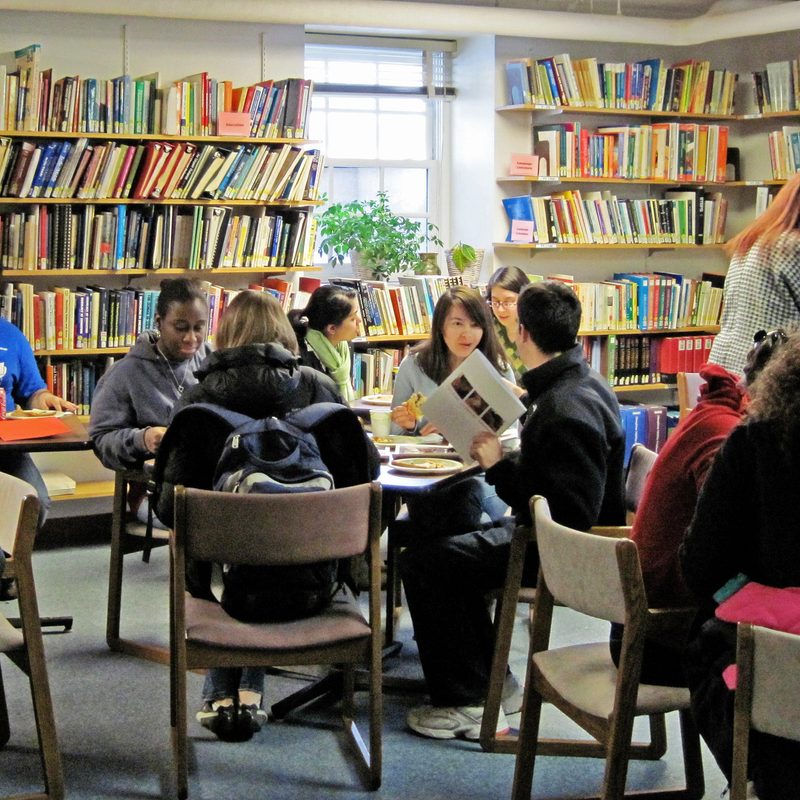
Educational Studies is an interdisciplinary field of study that explores education from numerous perspectives—psychological, sociological, historical, political, and philosophical. In our courses, you will meet students from almost every major on campus—united by a common belief in the importance of our schools and education’s role in a democratic society. Students in Educational Studies courses interrogate educational theory, policies, and practices and explore how schools can become accessible, equitable, and supportive spaces for all.

About Educational Studies
Educational Studies offers an interdisciplinary minor as well as general education courses open to all Carleton students. Several of our courses offer field experiences in local schools as well as opportunities to collaborate with a variety of community partners.
The Educational Studies minor provides an interdisciplinary approach to the study of education as an individual pursuit, an institutional venture, and a societal imperative. The minor aims to develop thoughtful, skillful and imaginative students of the psychology, social and cultural history, and politics of education. Students will pursue the study of education as a liberal art, one that both reveals the constraints of socialization and informs alternative visions of self and community. The minor is appropriate for students of all majors interested in the stewardship of education as a cornerstone of democracy.
While Carleton does not offer teacher licensure, we encourage Carleton students to consider careers as K-12 practitioners, scholars, researchers, advocates, and policy makers.
Educational Studies Minor
The Educational Studies Minor provides an interdisciplinary approach to the study of education as an individual pursuit, an institutional venture, and a societal imperative. The minor aims to develop thoughtful, skillful and imaginative students of the psychology, social and cultural history, and politics of education. Students will pursue the study of education as a liberal art, one that both reveals the constraints of socialization and informs alternative visions of self and community. The minor is appropriate for students of all majors interested in the stewardship of education as a cornerstone of democracy.
Requirements for the Educational Studies Minor
Minor Requirements – 42 Total Credits
All students will be required to take a minimum of seven courses: three core courses, three supporting courses and a senior seminar. Students interested in the minor are advised to begin their study during their sophomore year.
Core Course – Required 18 credits
- EDUC 110: Introduction to Educational Studies
- EDUC 234: Educational Psychology
- EDUC 338: Multicultural Education
Supporting Courses – Required 18 credits
Select one course from each of the three clusters; these courses must be from three different departments. The list below is not an exhaustive one. Please check the appropriate department pages for course descriptions and prerequisites and when courses are offered. We can neither control nor predict when courses from other departments are offered. If you have difficulty enrolling in a course for a particular cluster, please see the minor adviser to discuss other courses that might fulfill the requirement.
Cluster I Learning, Cognition and Development – (6 credits)
The purpose of this cluster is to provide additional perspective about how K-12 students develop physically, cognitively and socially. This cluster builds on the core course, Educational Psychology.
- CCST 100.02: Growing Up Cross-Culturally (26/FA)
- CGSC 130.01: What Minds Are & What They Do (26/FA)
- CGSC 130.01: Revolutions in Mind (27/WI)
- CGSC 130.01: Revolutions in Mind (27/SP)
- CGSC 232: Cognitive Processes
- EDUC 242: The Future is Now: Education and Technology in the 21st Century
- EDUC 262: Culturally Sustaining Pedagogy: Teaching and Learning in Diverse Classrooms (not offered 2026-27)
- PSYC 210: Psychology of Learning and Behavior
- PSYC 232: Cognitive Processes
- PSYC 250: Developmental Psychology
- PSYC 251: Lifespan Development (not offered 2026-27)
- PSYC 258: Social Cognition
Cluster II Social and Cultural Context of Schooling in a Diverse Society – (6 credits)
The purpose of this cluster is to provide an in-depth understanding of the broader historical, social and cultural context in which U.S. educational institutions are located. This cluster builds on the background knowledge provided by the core courses Introduction to Educational Studies and Multicultural Education.
- AMST 115: Introduction to American Studies
- DANC 270: Performance As Ceremony (not offered 2026-27)
- EDUC 262: Culturally Sustaining Pedagogy: Teaching and Learning in Diverse Classrooms (not offered 2026-27)
- EDUC 275: Inclusion or Refusal?: Educational Justice Models
- EDUC 278: Brainwashed! Education and Indoctrination, from Political Propaganda to Cults
- EDUC 280: Educating Citizens
- EDUC 340: Race, Immigration, and Schools (not offered 2026-27)
- EDUC 367: Culture Wars in the Classroom
- GWSS 110: Introduction to Gender, Women’s & Sexuality Studies
- HIST 114: Indigenous Histories, Time Immemorial to 1887 (not offered 2026-27)
- HIST 116: Intro to Indigenous Histories, 1887-present
- HIST 122: U.S. Women’s History to 1877 (not offered 2026-27)
- HIST 123: U.S. Women’s History Since 1877 (not offered 2026-27)
- HIST 125: Roots and Resistance: Africa to the U.S. Civil War (not offered 2026-27)
- HIST 126: Black Freedom: Reconstruction to #BlackLivesMatter (not offered 2026-27)
- HIST 203: American Indian Education 1600-Present (not offered 2026-27)
- HIST 228: Civil Rights and Black Power (not offered 2026-27)
- HIST 229: Working with Gender in U.S. History
- IDSC 100.01: Civil Discourse in a Troubled Age (26/FA)
- IDSC 203: Dialogue Across Differences (not offered 2026-27)
- PHIL 203: Bias, Belief, Community, Emotion (not offered 2026-27)
- POSC 302: Subordinated Politics and Intergroup Relations
- PSYC 384: Psychology of Prejudice
- RELG 140: Religion and American Culture
- SOAN 114: Modern Families: An Introduction to the Sociology of the Family
- SOAN 272: Sociology of Race and Ethnicity
- SOAN 283: Immigration, Citizenship, and Belonging in the U.S. (not offered 2026-27)
Cluster III Public Policy and Educational Reform – (6 credits)
The purpose of this cluster is to explore the public policy contexts, issues and questions that are most relevant to educational policy making and school reform. This cluster builds on the background knowledge provided by the core course Introduction to Educational Studies.
- ECON 270: Economics of the Public Sector
- EDUC 100.01: Will This Be on the Test? Standardized Testing and American Education (26/FA)
- EDUC 225: Issues in Urban Education (not offered 2026-27)
- EDUC 242: The Future is Now: Education and Technology in the 21st Century
- EDUC 245: School Reform: Yesterday, Today, and Tomorrow (not offered 2026-27)
- EDUC 250: Fixing Schools: Politics and Policy in American Education (not offered 2026-27)
- EDUC 278: Brainwashed! Education and Indoctrination, from Political Propaganda to Cults
- EDUC 280: Educating Citizens
- EDUC 325: Democracy, Schools, and Power (not offered 2026-27)
- EDUC 367: Culture Wars in the Classroom
- POSC 122: Politics in America: Liberty and Equality
- POSC 273: Race and Politics in the U.S.
Senior Seminar – Required 6 credits
- EDUC 395: Senior Seminar
Educational Studies Courses
-
EDUC 100.01 Will This Be on the Test? Standardized Testing and American Education
How and why have standardized tests become so central to our educational system? This seminar will explore the following topics, among others–the invention of standardized tests and the growth of the testing industry; psychometrics (the science of mental measurement); and the controversies surrounding the use of standardized tests, including charges that they are culturally biased and do not positively contribute to student learning. Our analyses will be informed by a close examination of authentic testing materials, ranging from intelligence tests to the SAT.
- Fall 2026
- 6
- AI/WR1, Argument & Inquiry/WR1
-
Student is a member of the First Year First Term class level cohort. Students are only allowed to register for one A&I course at a time. If a student wishes to change the A&I course they are enrolled in they must DROP the enrolled course and then ADD the new course. Please see our Workday guides Drop or 'Late' Drop a Course and Register or Waitlist for a Course Directly from the Course Listing for more information.
- Jeff Snyder 🏫 👤
-
EDUC 110 Introduction to Educational Studies
This course will focus on education as a multidisciplinary field of study. We will explore the meanings of education within individual lives and institutional contexts, learn to critically examine the assumptions that writers, psychologists, sociologists and philosophers bring to the study of education, and read texts from a variety of disciplines. What has “education” meant in the past? What does “education” mean in contemporary American society? What might “education” mean to people with differing circumstances and perspectives? And what should “education” mean in the future? Open only to first-and second-year students.
- Fall 2026, Winter 2027, Spring 2027
- 6
- IDS, Intercultural Domestic Studies SI, Social Inquiry WR2, Writing Rich 2
-
Student has Sophomore Priority.
- Anita Chikkatur 🏫 👤 · Ziye Wen 🏫 👤 · Jeff Snyder 🏫 👤
-
EDUC 225 Issues in Urban Education
This course is an introduction to urban education in the United States. Course readings and discussion will focus on various perspectives in the field in order to understand the key issues and debates confronting urban schools. We will examine historical, political, economic, and socio-cultural frameworks for understanding urban schools, students and teachers. Through course readings, field visits and class discussions, we explore the following: (1) student, teacher and researcher perspectives on urban education, (2) the broader sociopolitical urban context of K-12 schooling in cities, (3) teaching and learning in urban settings and (4) ideas about re-imagining urban education.
Not offered in 2026-27
-
EDUC 234 Educational Psychology
Human development and learning theories are studied in relation to the teaching-learning process and the sociocultural contexts of schools. Three hours outside of class per week are devoted to observing learning activities in public school elementary and secondary classrooms and working with students.
- Fall 2026
- 6
- SI, Social Inquiry
- Ziye Wen 🏫 👤
-
EDUC 242 The Future is Now: Education and Technology in the 21st Century
This course will examine the increasingly prominent role that technology is playing in education, inside and outside of schools. How is technology transforming teaching and learning? What are the potential costs and benefits of relying on technology to provide educational opportunities? Is technology re-wiring our brains? And who needs brains when we have Google and ChatGPT? This course will examine the following topics, among others: digital literacy, virtual reality, cyborgs and artificial intelligence.
- Spring 2027
- 6
- SI, Social Inquiry
- Jeff Snyder 🏫 👤
-
EDUC 245 School Reform: Yesterday, Today, and Tomorrow
This course explores major issues in the history of school reform in the United States, with an emphasis on the twentieth century. Readings and discussions examine the role of education in American society, the various and often competing goals of school reformers, and the dynamics of educational change. With particular focus on the American high school, this course looks at why so much reform has produced so little change.
Not offered in 2026-27
-
EDUC 250 Fixing Schools: Politics and Policy in American Education
How can we fix American public schools? What is “broken” about our schools? How should they be repaired? And who should lead the fix? This course will examine the two leading contemporary educational reform movements: accountability and school choice. With an emphasis on the nature of the teaching profession and the work of foundations, this course will analyze the policy agendas of different reform groups, exploring the dynamic interactions among the many different stakeholders responsible for shaping American education.
Not offered in 2026-27
-
EDUC 262 Culturally Sustaining Pedagogy: Teaching and Learning in Diverse Classrooms
This course focuses on the importance of integrating students’ cultural backgrounds in all aspects of learning. We will study various theoretical perspectives on culturally relevant, responsive, and sustaining pedagogy and will explore several school sites that incorporate that perspective into their approach to teaching and learning. Students will design and teach culturally sustaining curriculum from their own disciplinary background in K-16 setting.
Not offered in 2026-27
- 6
- IDS, Intercultural Domestic Studies SI, Social Inquiry
-
Student has completed any one of the following course(s): EDUC 100 or EDUC 110 with a grade of C- or better.
-
EDUC 275 Inclusion or Refusal?: Educational Justice Models
This era of local, state, and national pushback against policies and practices of “diversity, equity, and inclusion” provides us with an opportune moment to examine the possibilities and limitations of this framing as a pathway for educational justice. Drawing on critiques of liberal frameworks of educational equity by Indigenous scholars and scholars of color, this course will ask what educational justice might look like beyond representation and belonging, especially in higher educational institutions.
Recommended Preparation: One 100-level Educational Studies course.
- Fall 2026
- 6
- HI, Humanistic Inquiry IDS, Intercultural Domestic Studies
- Anita Chikkatur 🏫 👤
-
EDUC 278 Brainwashed! Education and Indoctrination, from Political Propaganda to Cults
Have you ever been indoctrinated? How would you know? What is the difference between education and indoctrination? This course will focus on the educational dimensions of “brainwashing.” Do cults have a curriculum? What lessons do people take away from political propaganda? How do people un-learn what they have been taught by phony “gurus” and domineering governments? We will analyze these questions by reading scholarly sources, watching documentaries, listening to podcasts, and carefully examining primary sources, from Chinese Cultural Revolution posters to the Church of Scientology’s online courses.
- Winter 2027
- 6
- IDS, Intercultural Domestic Studies SI, Social Inquiry
- Jeff Snyder 🏫 👤
-
EDUC 280 Educating Citizens
What does it mean to be a citizen in today’s world, and how do we learn to become one? This course examines the theory and practice of civic and citizenship education across local and national contexts, and explores how citizenship is taught, learned, and lived in schools, communities, and broader societal contexts. Students will analyze models of citizenship education, evaluate their underlying assumptions, and design their own approaches to fostering civic engagement.
-
EDUC 325 Democracy, Schools, and Power
One of the foundational elements of an ideal democratic society is an educated and informed public. Simultaneously, the maintenance of power in society demands control over what and how the public is educated. This class examines how schools in the U.S. serve both as sites of promoting democratic life and ideals as well as reproducing social, political, and economic oppression. Throughout the class, we will explore the relationships, tensions, and contradictions between schools, power, and democracy with the goal of answering whether schools can protect and save democracy.
Not offered in 2026-27
-
EDUC 338 Multicultural Education
This course focuses on the respect for human diversity, especially as these relate to various racial, cultural and economic groups, and to women. It includes lectures and discussions intended to aid students in relating to a wide variety of persons, cultures, and life styles.
- Spring 2027
- 6
- IDS, Intercultural Domestic Studies SI, Social Inquiry
-
Student has completed any of the following course(s): One 100 or 200 level Educational Studies (EDUC) course with grade of C- or better.
- Anita Chikkatur 🏫 👤
-
EDUC 340 Race, Immigration, and Schools
This course explores the important role that public schools have played in the American national imagination as the way to socialize students about what it means to be American and to prepare them to participate as citizens in a democracy. Focusing on two periods of high rates of immigration into the United States (1890-1920 and 1965-present), the course examines how public schools have attempted to Americanize newly arrived immigrant children as well as to socialize racial minority children into the American mainstream. While most of the readings will focus on urban schools, the course will also consider the growing immigrant populations in rural schools through readings and applied academic civic engagement projects.
Not offered in 2026-27
- 6
- IDS, Intercultural Domestic Studies SI, Social Inquiry
-
Student has completed any of the following course(s): One 100 or 200 level Educational Studies (EDUC) course with grade of C- or better.
-
EDUC 367 Culture Wars in the Classroom
This course examines past and present school controversies, including school prayer, banned books, and student protests. Who controls the curriculum? How do we teach contentious issues such as evolution, racism, and climate change? To what extent do teachers and students enjoy the right to free expression? These are the kinds of questions “Culture Wars in the Classroom” will explore, as we consider the purpose of public education in a diverse, multicultural nation.
- Winter 2027
- 6
- IDS, Intercultural Domestic Studies No Exploration
- Jeff Snyder 🏫 👤
-
EDUC 395 Senior Seminar
This is a capstone seminar for educational studies minors. It focuses on a contemporary issue in American education with a different topic each year. Recent seminars have focused on the school to prison pipeline, youth activism, intellectual freedom in schools, and gender and sexuality in education. Senior seminars often incorporate off campus work with public school students and teachers.
- Spring 2027
- 6
- No Exploration
-
Student is an Educational Studies minor.
- Anita Chikkatur 🏫 👤