ACM Wilderness Field Station
1997 Program

Field Study In One Of America's Outstanding Wilderness Areas
The Associated Colleges of the Midwest (ACM)
has operated its Wilderness Field Station since 1962, giving college
students a unique opportunity to learn through field studies in one
of America's outstanding wilderness areas.
Located on remote Low Lake in the Superior National Forest of
Minnesota, the Station provides direct canoe access to the
Boundary
Waters Canoe Area (BWCA) and the adjoining Quetico Provincial
Park of Ontario. Together, these protected areas comprise several
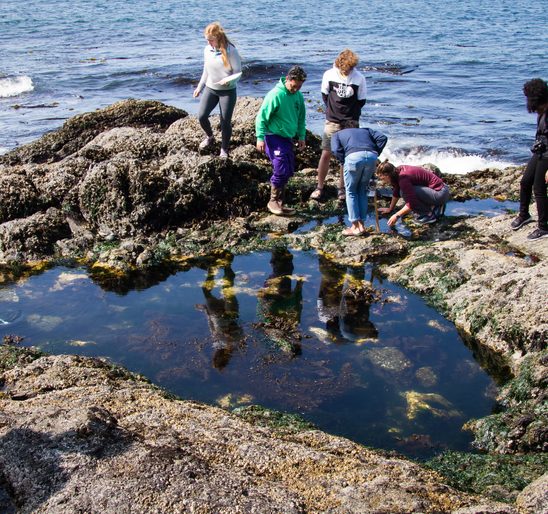
million acres of forests, lakes and streams, enabling close
observation and study of numerous, diverse habitats and species.
Classes are small and personal, with no more than eight students
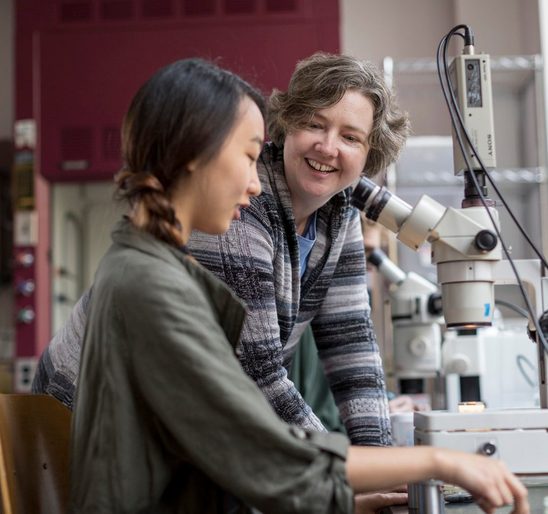
per instructor. All courses integrate lectures and laboratory
investigation with wilderness field work and a 10-day canoe trip.
Most courses include an intensive individual research component and
paper.
Students also have opportunities to hear guest speakers on topics
such as bears and mustelids, forest ecology, biogeography and the
history of philosophical attitudes toward the wilderness.
Please follow the following links for further information.
Eligibility
Academic program (courses offered)
Living arrangements
Costs
Application procedures
Application deadlines
Campus program advisors
Program directors
ACM
Eligibility
All students with an interest in the wilderness are encouraged to
apply.
Except as noted, one college level biology course or its
equivalent is required.
Academic program
- Dates
- First Session: June 16 - July 17,
1997
- Second Session: July 17 - August
18,1997
- Enrollment
- A maximum of 8 students per class. Students may apply for one
or both sessions, enrolling in one course each session.
- Credit and grades
- Recommended credit is four semester hours or the equivalent
for each course. However, each college has its own policies, so
students should consult the campus program advisor or off-campus
studies officer for their college's credit and grading policies
for this program. It is the student's responsibility to determined
in advance the amount and distribution of credit.

First session courses
(Extended course
descriptions available from ACM)
- Behavioral Ecology of Vertebrates
- Behavioral ecologists study behavioral strategies used by
organisms to improve their evolutionary success. We begin by
studying the plant communities and environmental forces in the
boreal forest, then identify members of the major vertebrate
groups by sight, sound and other cues. With this background we
study such topics as interactions among members of the same and
different species, habitat choice, foraging, reproduction,
spacing, competition and predation with the goal of understanding
the evolutionary significance of these behaviors. Harlo Hadow (Coe
College)
- Comparative Ecology of Lakes and Streams
- The course will examine the biota of area lakes and streams
and their physico-chemical milieu. A comparative ecosystem
approach will be used to structure field and laboratory
experiments. Readings, discussion and lectures will be used to
enrich and enhance the experimental work. The course will include
an overview of regional and North American lake and stream
biodiversity, and the effects of introduced species and human
intervention on aquatic ecosystems. Michael C. Swift (Carleton
College)
- Environmental History of North America
- This course will examine major issues in environmental history
by focusing on the Quetico-Superior region from the 17th century
to the present, with an emphasis on the 20th century. Major themes
will include the environmental aspects of European expansion,
subsistence economies and their role in the cultures and
dispossession of Indian peoples, the environmental effects of
modern economies, different understandings of nature, and more
recent local and national conflicts over environmentalism. We will
use the area both to directly experience the wilderness and to
interview local representatives of the environmental and wise-use
movements who perceive the same wilderness in fundamentally
different ways. No prerequisite. Benjamin H. Johnson (Yale
University)
-
- Landscape Ecology of the Boundary Waters Using CIS and GPS
- In this course, students will use GPS (Global Positioning
System) receiversand GIS (Geographic Information System) software
to sample and map the mosaic of landscapes in the Boundary Waters
and Quetico region. This will involve classification of
communities based on field surveys of selected wetland and forest
sites, analysis of biological and positional data, and the
construction of coded maps. Canoe trips into Canada will furnish
landscape comparisons that will improve the accuracy of the maps.
The course combines traditional field research skills with new
methods of ecological analysis. Students must be willing to
enthusiastically engage the challenges of working with computers
in a field setting.
Prerequisites: an introductory college biology course with an
ecological component and familiarity with a word-processing
program and spreadsheet or statistical software. Paula Sanchini
(Coe College)
-
- Independent Study
- Students with previous experience at the Field Station may
pursue individual or team projects. Staff.
Second session courses
(Extended course
descriptions available from ACM)
- Behavioral Ecology of Mammals
- Students will study the ecology and behavior of mammals in the
Quetico-Superior Region from an evolutional perspective. What do
the local mammals eat and why? How do they get their food? How do
they behave towards other members of their species? What are their
relationships with other species? Students will also learn basic
natural history and anatomy necessary to help them answer such
questions. Roger Powell (North Carolina State University)
- Environmental Issues of the Northwoods
- The course examines environmental issues in northern Minnesota
and neighboring Canada. Global impacts such as ozone depletion,
acid rain and global climate change will be studied and discussed,
along with local issues of deforestation, tourism, shoreline
degradation, pollution and introduced species. Topics will be
examined from biological, sociological, economic and political
perspectives. No prerequisites. Neil Bernstein (Mount Mercy
College)
- Life of Insects
- In championing insects for experimentation and study, the
eminent physiological ecologist Bernd Heinrich, who has studied
everything from weasels to ravens, states "For me, insects are a
logical choice. There is no other group of animals that rivals
them in diversity. They are found everywhere, often in astounding
abundance. They can be observed at close range.... Also, they face
many of the same problems we do." If you aspire to a research
career in the fields of ecology or behavior, the study of insects
as a model system or an insect as an experimental organism
provides an excellent point of departure.
This course provides undergraduates a rare opportunity to study
insects before graduate school. A major focus of the course will
be the examination of ecology and behavior in the field. Students
will learn to identify the various insect orders and families and
contrast their physiological systems to our own. We will discover
burying beetles that entomb dead organisms within crypts beneath
the ground, scorpion flies that gain mates by raping and
pillaging, and damsel flies whose males insure paternity by
scooping out a rival's sperm from their mates with a copulatory
scrub brush. The boundary waters of the Quetico-Superior provide
an ideal location to learn about this important group of
organisms. Kurt Redborg (Coe College)
- Wetland Ecology
- Wetlands are unique and mysterious ecosystems that present an
array of biological, chemical and physical challenges to the
organism that live within them. Students will study the wetlands
in order to identify how plants and animals have adapted to these
challenges. The role of wetlands in global climate change and
paleo-ecological research will be introduced. History of wetland
protection and exploitation will be discussed in the context of
wetland policy. A canoe trip into Quetico Provincial Park and the
BWCA will allow students to study a variety of wetland
communities, such as bogs, fens and swamps. Field surveys and
observations will emphasize plant communities, adaptations of
plants and animals, and wetland succession and development.
Students will design and conduct a field research project. Anne
Capistrant
- Independent Study
- Students with previous experience at the held Station may
pursue individual or team projects. Staff.
Living arrangements
Base camp facilities, while comfortable, are remote from town and
purposely minimal to intensify contact with the wilderness. Buildings
include laboratories, a dormitory and a kitchen/ mess hall. Students
stay at the camp when not on field trips, and must bring the academic
materials and personal effects needed for an extended stay in the
woods.
Costs
Students are billed tuition and a program fee by their colleges.
Students from non-ACM colleges should consult the ACM office in
Chicago.
Tuition
For students from ACM colleges, tuition for each course will equal
approximately one-ninth of the Carleton college 1996-97 tuition, and
is paid directly to Carleton.
Tuition refunds are made in accordance with the policy in effect
on the home campus.
Program fee
The program fee for 1997 is tentatively set at $750 per session,
but is subject to change. The fee covers room and board at the Field
Station. No part of the program fee expended on a student's behalf is
refunded if the student withdraws from the program. Students from
non-ACM colleges are also charged a $125 administrative fee.
Other expenses
Because students cannot travel into town during the program,
spending money is not necessary. Personal and academic supplies
should be purchased before departure for the Field Station. Students
are responsible for transportation costs to and from the Field
Station. In the past, ACM has chartered a bus from Duluth to the
Field Station and back and billed students at the end of the program.
How to apply
- Pick up application materials from the campus program advisor.
Students from non-ACM colleges should contact the ACM office in
Chicago.
- Check with the program advisor for the application deadlines
on your campus.
- The program advisor can answer your questions about the
program and perhaps put you in touch with past participants from
your campus. Recent Carleton participants are Joe Short, Jason
Fishbach, Sarah Davies, Emily Burton, Amy Moore, and Laura Saxton
for the summer of '96, and Heater Kieweg, Smita Mehta, and Jim
Crants for the summer of '95.
- Check with the program advisor and/or off-campus studies
office about the amount and distribution of credit for the
program.
- Return the completed application to
the program advisor by your campus' deadline. ACM must receive
completed applications (having gone through all on-campus
procedures) by February 20. Decisions will be announced in early
March.
Applications received at the ACM office (having gone through
all on-campus procedures) by April 15 are eligible for late
acceptance on a space-available basis.
- If you're accepted, pay a non-refundable $300 deposit directly
to the ACM office in Chicago to secure your place. The deposit
will be applied to your program fee.
ACM Wilderness Field Station
Campus program advisors
- Beloit Richard Stenstrom
- Carleton Gary Wagenbach
- Coe Harlo Hadow
- Colorado Alexandra Vargo
- Cornell Robert Black
- Grinnell Jonathon Brown
- Knox Eugene Perry
- Lake Forest Kenneth Weik
- Lawrence Brad Rence
- Macalester Mark Davis
- Monmouth Kenneth Cramer
- Ripon George "Skip" Wittier
- St. Olaf Kathleen Shea
- U. of Chicago Lewis Fortner, Stephen
Pruett-Jones
For more information, contact:
Associated Colleges of the Midwest
205 W. Wacker Drive, Suite 1300, Chicago, Illinois 60606
Phone: 312/263-5000
E-mail: acm@acm.edu
For specific answers to questions about
courses, prerequisites or independent study, contact either of the
directors of the program:
First Session
Professor Harlo Hadow
Dept. of Biology, Coe College
1220 First Avenue NE
Cedar Rapids, IA 52402
Phone: 319/399-8704
E-mail: hhadow@coe.edu
Second Session
Professor Kurt Redborg
Dept. of Biology, Coe College
1220 First Avenue NE
Cedar Rapids, IA 52402
Phone: 319/399-8703
E-mail: kredborg@coe.edu
The Associated Colleges of the Midwest does not discriminate
in the operation of its educational programs, activities or
employment on the basis of sex, race, creed, national origin, age,
sexual orientation or handicap.
Page built by Hans Landel with help from ACNS, Carleton
College.